
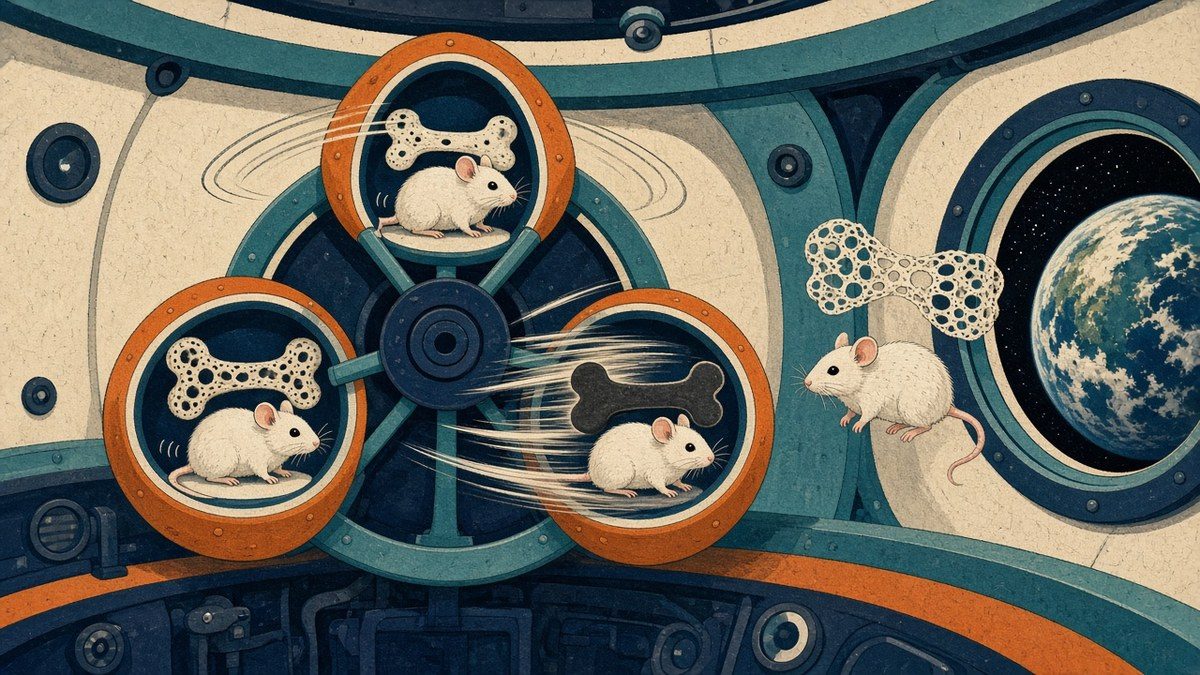
Anyone planning a long trip to Mars, or a spinning space station, needs to know how much gravity a body needs. A new mouse study gives one answer for bone, and it's a demanding one.
The experiment. Young adult male mice, 11 weeks old, spent 30 days on the International Space Station. Some floated in microgravity. Others rode onboard centrifuges that produced artificial gravity at 0.33 G, 0.67 G or a full 1 G. Each group had five or six mice. Twelve ground-control mice lived in identical habitats on Earth. [1] The mice flew in the Japan Aerospace Exploration Agency's Mouse Habitat Unit on the SpaceX-27 mission, which ran from March 14 to April 15, 2023, according to NASA's Open Science Data Repository. [2]
The result. "Mice exposed to 1 G of AG had equivalent bone mass, microarchitecture, and strength compared to HGC, but lower levels of AG only partially mitigated these bone deficits," the authors wrote, using their shorthand for artificial gravity (AG) and habitat ground controls (HGC). [1] Their conclusion: "1 G of artificial gravity was necessary to ameliorate most of the microgravity-associated deficits in bone health." [1]
There were other findings. Spaceflight caused "a marked increase in total body fat mass," which artificial gravity prevented in a dose-dependent fashion. Gene activity in the cortical bone shifted in weightless mice and moved back toward the ground controls as gravity increased. [1] The partial levels did help, but "not consistently in a dose-associated manner," the paper says. More gravity did not always mean proportionally better bone. [1]
The paper, "Impact of artificial gravity on spaceflight-induced skeletal deterioration in male mice," was published open access in npj Microgravity on Nov. 13. Its first author is Anna W. Beverly and its senior author is Mary L. Bouxsein of Beth Israel Deaconess Medical Center and Harvard Medical School. [1][2] NASA's repository posted the bone RNA-sequencing data as a new public release on Nov. 18, so anyone can check the work. [2]
Why it matters. Mars's surface gravity is about 0.38 G, close to the study's one-third level. Commentators on Digg pointed out that a related paper from the same campaign found muscle needed only about two-thirds gravity for full protection. If that holds, bone, not muscle, may set the bar for how much artificial gravity crews need. [3] That muscle comparison comes from social posts summarized on Digg, not from the bone paper itself.
The caveats are real. These were young male mice, in groups of five or six, for 30 days. Long missions last years, and people are not mice. The authors called the partial-gravity results inconsistent. [1] The data took three and a half years to go from orbit to publication. [1][2]
Commentary. This is what productive cooperation with a real ally looks like. Japan built and ran the centrifuge habitat, and NASA and the NIH helped pay for the science. The paper says the result came from the "Japan-U.S. Open Platform Partnership Program." [1] And the raw data is public, on a NASA server, for anyone to download. That is how taxpayer-funded science should work: open data, a clear result, and limits stated plainly. If Washington wants humans on Mars, this is the kind of basic work it should keep funding.