
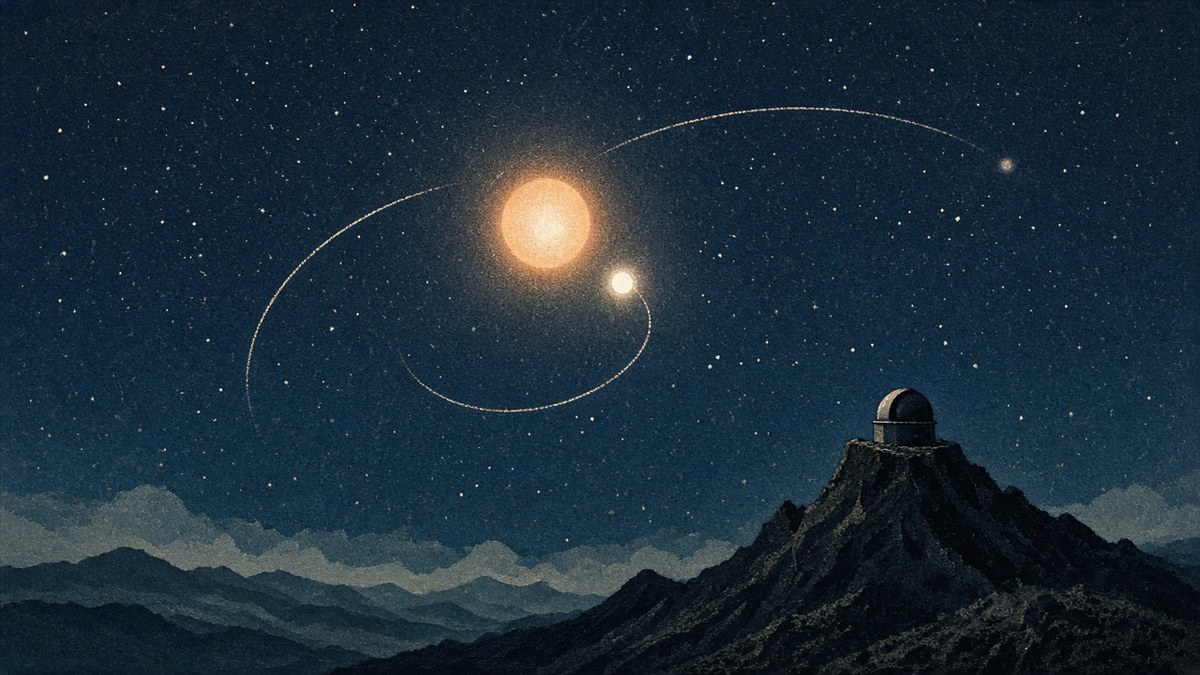
Astronomers searching for planets around an ordinary red dwarf star 28 light-years from Earth instead found a hidden dead star next to it. They now say the pair should not exist.
The system is now named Welopōʻai and was previously catalogued as IRAS 21500+5903. It is described in a study by an international team led by Étienne Artigau of the Trottier Institute for Research on Exoplanets at the Université de Montréal, published Nov. 19 in Astronomy & Astrophysics. [1][2] It has three stars: a small red dwarf, a newly found white dwarf orbiting close to it, and a second white dwarf, already known, orbiting the pair from farther out. [1][2][3] The paper calls it "the closest known triple containing multiple white dwarfs" and says the arrangement "has no known analogue within 30 pc," or about 98 light-years. [1]
How they found it. The team was using SPIRou, an instrument on the Canada-France-Hawaii Telescope on Maunakea, Hawaiʻi, which spots planets by measuring tiny wobbles in a star's speed. This red dwarf's speed swung by about 16 kilometers per second, peak to peak, which the paper says is "inconsistent with planetary companions." [1] CBC reported that the readings were so far off they broke Artigau's analysis code. "It's a freak thing," Artigau told CBC. "It was an annoying object. It's not what we were looking for." [3]
The unseen companion turned out to weigh more than half as much as the Sun while giving off almost no light. "The unusual combination of high mass and very low brightness left only one plausible explanation: it was the remnant of a dead star," co-author Charles-Antoine Parent of Université Laval said in the university's release. [2] The team then used the 'Alopeke camera on the Gemini North telescope, run by the U.S. National Science Foundation's NOIRLab, and imaged it directly: a white dwarf. [1][2]
The numbers. According to the paper, the inner white dwarf has about 0.618 times the Sun's mass, measured to within 0.7 percent, which the authors call the most precise such measurement for any white dwarf within 20 parsecs. The red dwarf has about 0.419 solar masses. The two orbit each other every 9.83 years at an average distance of about 4.6 times the Earth-Sun distance (astronomical units, or AU). The outer white dwarf lies at a projected 123.9 AU. [1] The reports disagree here. CBC described the inner pair as about two AU apart and the outer white dwarf as roughly 1,000 AU away. [3] We are going with the peer-reviewed paper's figures.
Why it "shouldn't exist." Before it died, the inner white dwarf was a star about 40 percent heavier than the Sun. As it aged, it swelled into a giant several hundred times its original size, the university said, and its red dwarf neighbor was close enough that a violent interaction was "almost inevitable." [2] Pairs like this often end with one star swallowing the other or the two merging. This red dwarf survived and sits in a surprisingly wide, stable orbit. [2][3] "This system should not exist," co-author Patrick Dufour said. "We have no clean explanation for how it got here." [2] The team suspects the outer white dwarf helped stabilize things, but how is still unknown. [3]
The name Welopōʻai came through A Hua He Inoa, a naming program of Hawaiʻi's ʻImiloa Astronomy Center. It combines welo (an inherited family trait) and pōʻai (an orbit), for "path of family traits." [2] The planet hunt isn't over. Artigau told CBC co-author Atanas Stefanov is applying for telescope time to look for planets around the red dwarf. [3]