
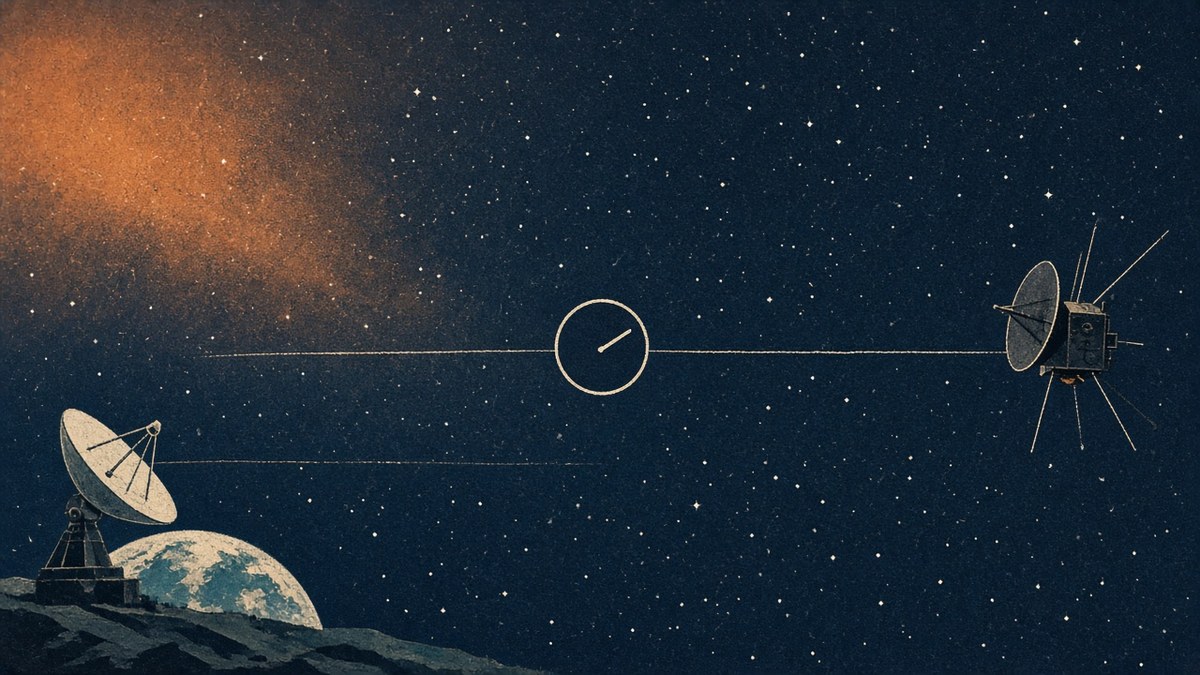
Print the timing exactly, because the timing is the story. Voyager 1 reached one light-day from Earth at 2:16 a.m. PST on November 18 — and NASA confirmed it on Thursday, November 19, when the signal the probe sent 24 hours earlier reached flight controllers at NASA's Jet Propulsion Laboratory in Southern California [1][2]. One light-day is the distance light travels in 24 hours: about 16.1 billion miles, or 25.9 billion kilometers [1].
Voyager 1 launched in 1977, has been traveling for more than 49 years at about 38,000 mph, and entered interstellar space in 2012 — the first spacecraft to leave the heliosphere [1][2]. Its twin, Voyager 2, crossed in 2018 and will not reach one light-day until 2035 [2]. Both probes carry the Golden Record, a gold-plated copper phonograph of Earth images and sounds, and both lose about 4 watts of power a year as their plutonium depletes; earlier this year engineers turned off three devices on Voyager 1 and substituted three lower-power alternatives, and NASA expects enough power to keep the current instrument suite running until at least the probes' 50th launch anniversaries next summer [1].
JPL director Dave Gallagher: "Voyager 1 crossing the light-day threshold is yet another historic feat on an extraordinary voyage of discovery" [1][2]. Joe Westlake, director of NASA's Heliophysics Division: "Traveling a light-day is a singular feat for a spacecraft, but Voyager is so much more than a distant traveler" [1]. Project manager Suzanne Dodd put the new arithmetic of the mission plainly: "We listen to Voyager 1 every day and send commands to the spacecraft weekly. It just takes a little longer to communicate than it used to." "Even traveling at the speed of light, signals now take 24 hours to reach the spacecraft and 24 hours to reach us" [1]. Project scientist Linda Spilker: "The Voyagers are revolutionizing our understanding of interstellar space, a previously unexplored region outside the heliosphere" [1].
The caveat rides in the same paragraph as the triumph, because NASA put it there. The agency has not received science and engineering data from Voyager 1 since November 14; engineers confirmed the milestone using the carrier signal — the tone that normally carries that data — plus trajectory calculations, and are still analyzing the data issue [1][2]. A machine 49 years old, a full day away at light speed, has gone quiet in one channel while its tone still arrives on schedule. NASA is working the problem at a two-day round-trip distance, and this paper will print what they find when they find it.