
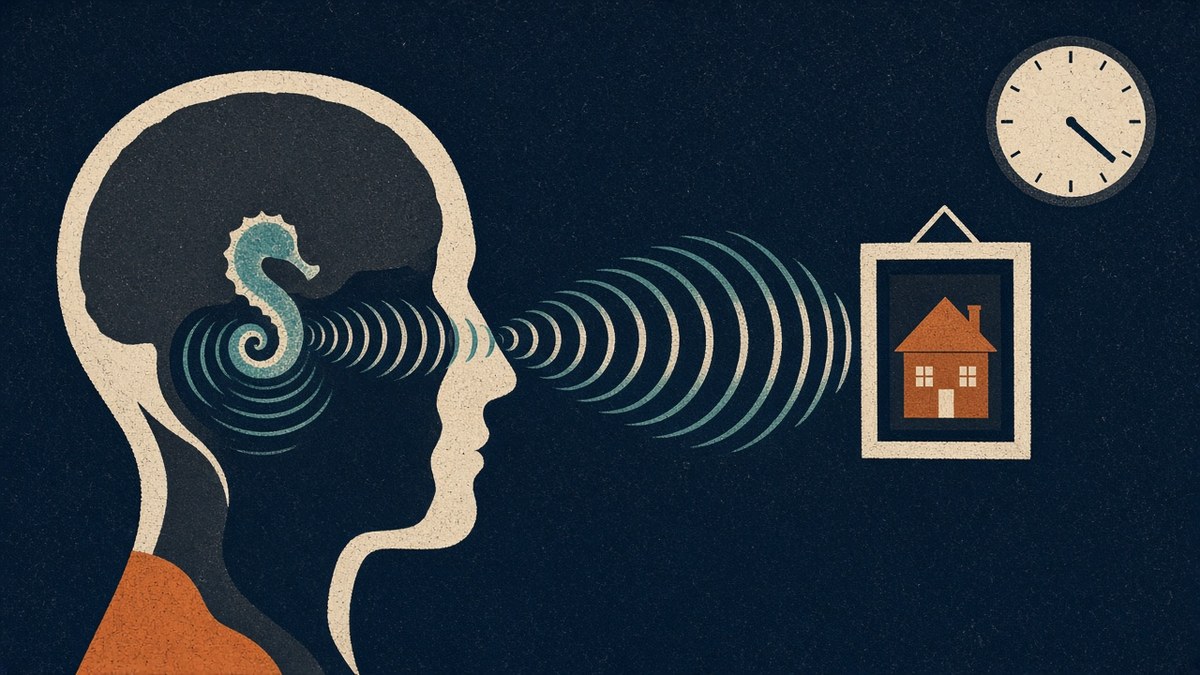
The setup is rare enough to state plainly. Researchers led by Jing Liu at South China Normal University and Ying Cai at Zhejiang University analyzed intracranial electroencephalography data from 13 patients with drug-resistant epilepsy who had depth electrodes implanted for clinical evaluation [1]. The participants performed a delayed match-to-sample task: view an image, hold it in mind across a seven-second maintenance period, then judge whether a probe picture matched the original or a similar lure [1]. The study was published in eLife on November 20, 2026 [1].
The finding: as participants maintained the images, the rate of hippocampal ripples — brief high-frequency oscillations — progressively increased over time, a pattern the authors call ramping up [1]. That ramping effect occurred on trials where participants successfully remembered the images, pointing to a link between rising ripple rates and memory accuracy [1]. Hippocampal ripples were also frequently coupled in time with ripples in the lateral temporal lobe, a region involved in representing visual information, within a window of fifty milliseconds; when the ripples synchronized, they coincided with reactivation of specific memory representations in the lateral temporal lobe, and decoding analysis showed higher accuracy on those trials [1]. Crucially, the ramping and coupling did not differ between items later remembered in a long-term test and items forgotten — suggesting the dynamics serve online maintenance of visual information rather than long-term storage [1].
Why it matters: hippocampal ripples were established in post-learning sleep, where they coordinate replay of neural firing patterns and are implicated in transferring representations to cortical networks during memory consolidation [2]. This study asks whether the same bursts also work while you are awake, holding a picture in mind for seven seconds [1][2].
Now the caveats, in the open, because eLife publishes its reviews alongside the paper. Reviewer #1 called the results "compelling novel evidence for a role of ripples in supporting human visual short-term memory" [2]. Reviewer #2 raised a detection concern: the 70–180 Hz detection band overlaps high-gamma activity, and a 2026 Nature Communications study found many awake ripple detections reflect false positives from noise [2]. Reviewer #3 was bluntest: the basic finding is "intriguing and previously not shown as far as I know, but a lack of control analyses within the task, across brain regions, or as compared to alternative oscillatory signals makes the overall evidence weak" [2]. Thirteen patients, all with drug-resistant epilepsy and clinically implanted electrodes, is a small and specific sample, and this paper does not generalize it to every brain.
Grade it as it sits: a peer-reviewed eLife study with direct intracranial recordings, a novel ramping result, and published reviewer disagreement about whether the signal is truly ripples or general high-frequency activity [1][2]. The data and code are publicly available on OSF, per the reviewers [2] — so the argument can be settled by anyone willing to run the numbers.