
The sample size is twelve. The conclusion reaches past Neptune.
NASA announced on November 18 that researchers at its Johnson Space Center, working with colleagues at the University of California, Los Angeles, have found what NASA calls the strongest evidence yet for an ancient reservoir of ice enriched in heavier oxygen isotopes in the Kuiper Belt, the distant region beyond Neptune [1]. The peer-reviewed study, led by planetary scientist Lindsay Keller, was published in Science Advances under the title "A primordial heavy water reservoir in the outer solar system" [2].
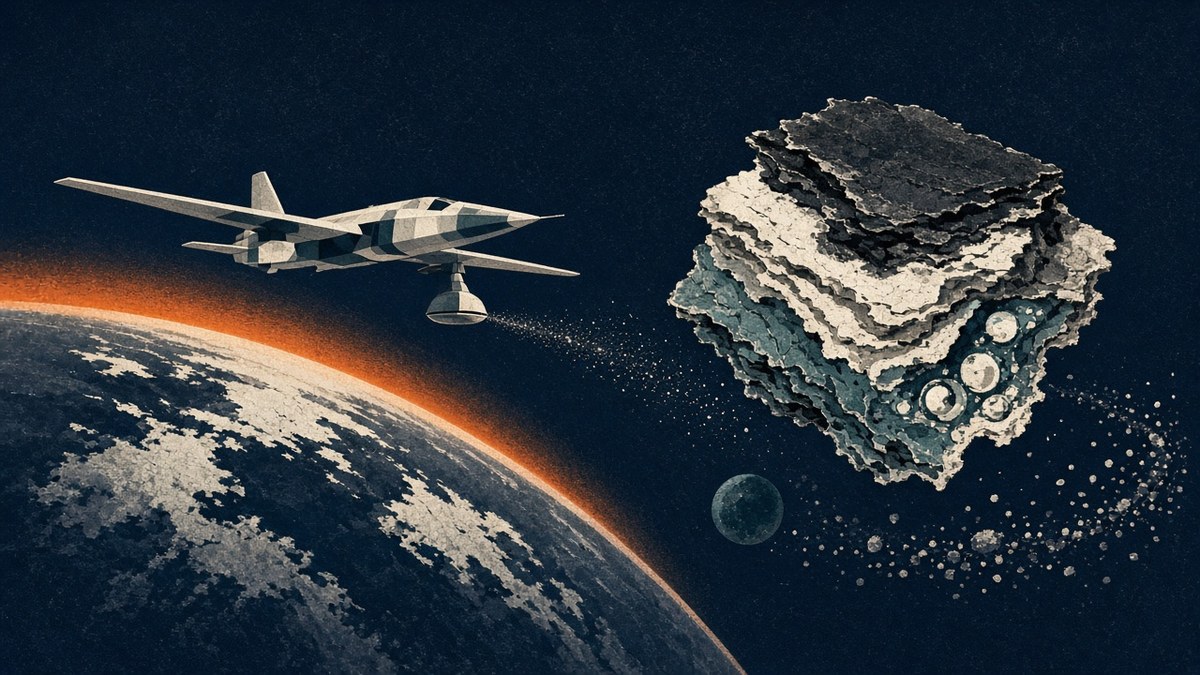
The evidence arrived the slow way. The team analyzed 12 interplanetary dust particles, 10 to 30 micrometres across, collected from Earth's stratosphere by NASA's ER-2 high-altitude research aircraft [1][2]. Using advanced electron microscopy at NASA and an ion microprobe at UCLA, they read the particles' minerals and oxygen isotopic compositions [1]. High concentrations of solar energetic particle tracks — 50 to 200 billion per square centimetre, roughly 100 times higher than in asteroid-belt or Jupiter-family comet dust — traced the grains' origin to the Kuiper Belt rather than the inner system [2][3].
Inside the grains sits the water story. Their mineralogy is dominated by hydrated clays — mainly saponite, with minor serpentine — minerals that form when water reacts with rock at low temperatures [2][3]. In plain terms: liquid water once altered the parent bodies these grains came from, out where the Sun is a bright star and everything is supposed to be frozen solid and dry of history. The modelled ancient water carries a heavy-oxygen signature, Δ17O of about +62 parts per thousand, against +3 to +7 in the water recorded in carbonaceous chondrite meteorites [2][3]. The paper's own conclusion: the grains provide "compelling evidence for the presence of a major heavy water reservoir beyond the orbits of the gas giant planets that was largely isolated from inner solar system materials" [2].
Why the isolation matters: measurements from NASA's Genesis mission give the reference for comparing oxygen isotopes, and the scarcity of this heavy signature in meteorites suggests the giant planets limited mixing between the outer and inner solar system while the planets were forming [1]. The outer system's water, on this evidence, stayed its own.
The caveats ride in the same paragraph as the wonder, because twelve grains demand them. The sample is 12 particles; their parent bodies are unknown; and the water values are modelled from minerals, not measured in water itself [2][3]. What the study establishes is a signature and an origin — the strongest yet, per NASA — not a map of the reservoir or a sample of its ice [1].
Twelve specks of dust, caught by an airplane flying at the edge of the sky, carrying clay that only forms in water, from bodies beyond Neptune that were never supposed to have any. The early solar system, it turns out, kept its water in more places — and kept it more separate — than the textbooks had it.