
For decades the textbook story went like this: Homo erectus was a savanna-and-woodland species, and when rainforest crept in, it couldn't cope. Two papers published Wednesday in Nature say that story is wrong.
Homo erectus emerged in Africa nearly two million years ago and spread across Asia as far as Java, Indonesia. [1][2] Before these finds, scientists had no securely dated H. erectus fossils on the Asian mainland younger than about 400,000 years. [2] The last known members lived on Java until roughly 110,000 years ago, and encroaching rainforest has often been blamed for their end. [2]
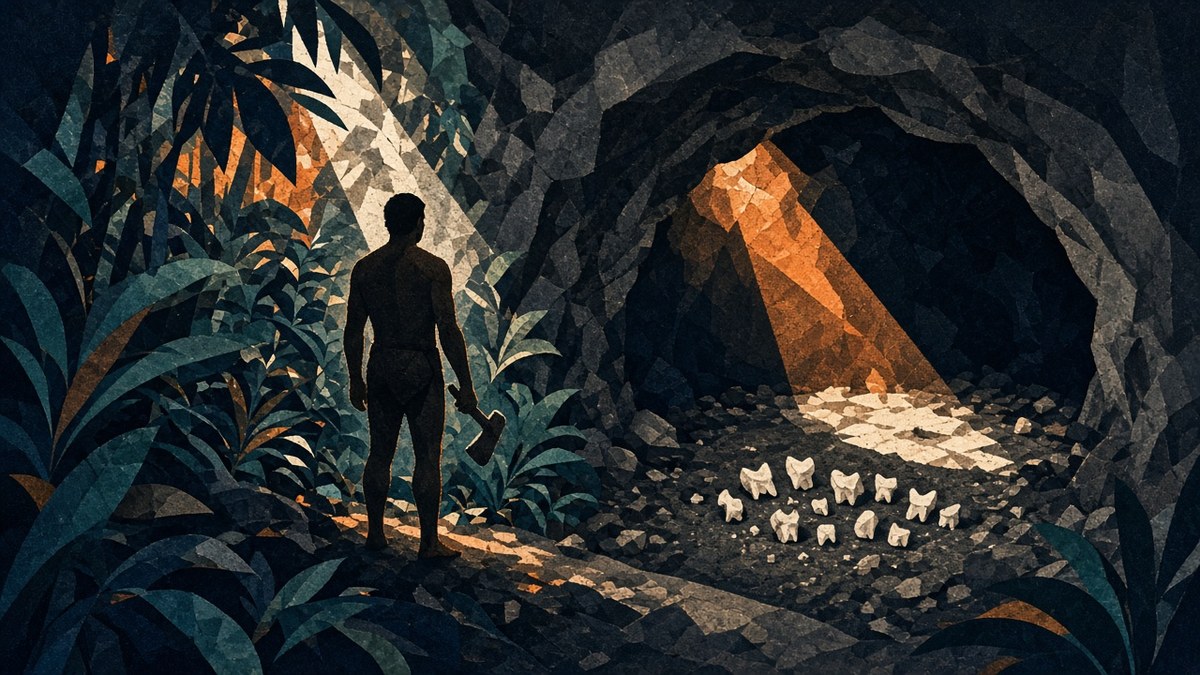
The new evidence comes from Naxian Cave and Baxian Cave, two limestone caves in Guangxi province in southern China. [1][2] A team led in part by Kira Westaway, a geochronologist at Macquarie University in Sydney, was hunting fossils of Gigantopithecus, a three-meter-tall extinct ape. [1] They found more than 10,000 fossil teeth, from orangutans, monkeys, wild boar, muntjac deer and leopards, probably hauled in by a scavenger such as a porcupine. [1] Nine of the teeth were human-like. [1]
Westaway's team dated the fossil layers with five independent methods and placed the hominin teeth between about 324,000 and 184,000 years ago. [2] Carbon isotopes in the animals' tooth enamel showed they fed only in closed-canopy forest, and the H. erectus teeth carried the same signature. [2] That means these people weren't passing through. They lived in the jungle.
"Never, ever have we seen them in rainforests," Westaway told Nature. "This is a really big deal, because we thought Homo sapiens were the only species that had the skill set to survive in really challenging rainforest environments." [1]
They also traveled. Strontium in the H. erectus teeth, which reflects the rock under the food and water a person grew up on, didn't match the local limestone, suggesting they ranged widely, possibly from as far as northern Vietnam, about 250 kilometers away, according to Scientific American. [2]
The second paper, led by researchers including Frido Welker, a molecular anthropologist at the University of Copenhagen, read ancient proteins preserved in tooth enamel. [1][2] Proteins "fall apart inherently slower than ancient DNA does," Welker said. [2] Four of the teeth were confirmed as H. erectus this way, and one enamel-protein variant pattern suggests they belong to a previously unknown lineage of the species. [1][2]
The ninth tooth is the puzzle. It doesn't match H. erectus, Neanderthals or modern humans. [1][2] Welker said Denisovans "would be the first option to consider," but cautioned that there is no comparable Denisovan tooth to check against, and that "every label we put on that ninth tooth is a little bit of speculation." [1][2]
Outside researchers were impressed but careful. Susan Antón of New York University said the work "emphasizes that behavioral flexibility was likely a key to Homo erectus success." [2] Karen Baab of Midwestern University said she hopes future fossils from southern China can confirm the species call. [2] Westaway's team goes back every year, with cavers exploring four or five caves a day. [2]