
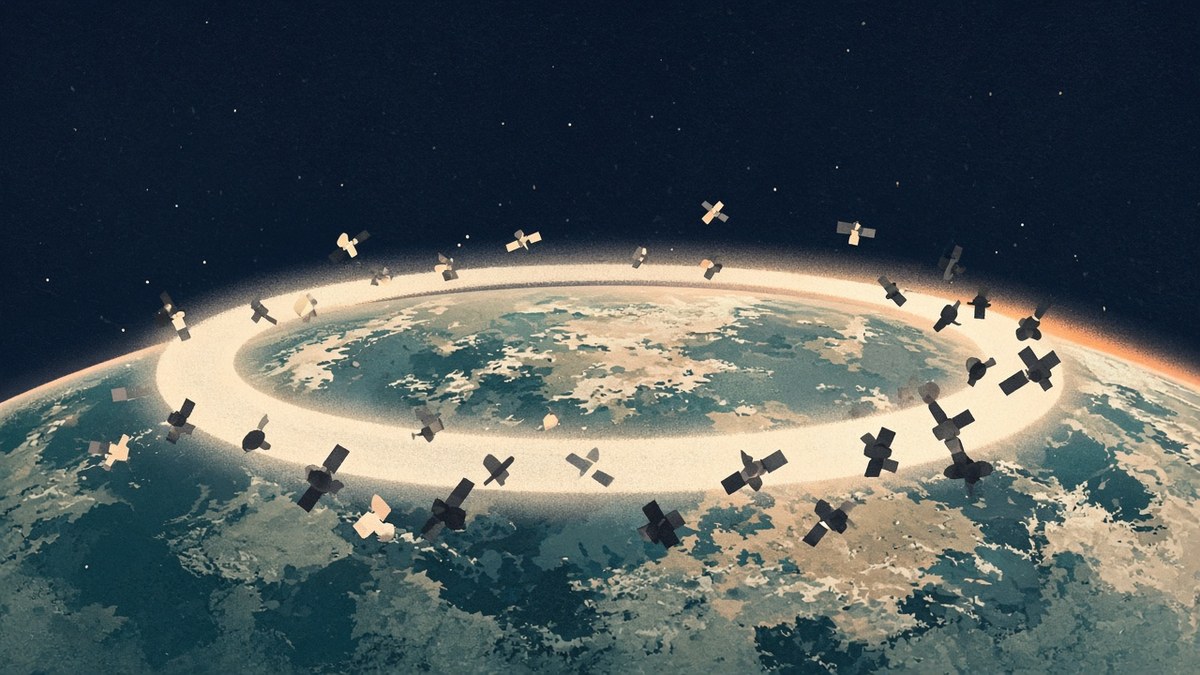
A single nuclear weapon set off in low Earth orbit would knock out about 98% of the satellites there within a week. That is the central finding of a new preprint from researchers at the University of Wisconsin–Madison and Princeton University, and it has spread widely this week. [1][2][3]
The team, led by Zachary Petersen with Hong Qin, Sarah Thiele and Sébastien Philippe, modeled a 1-megaton detonation 500 kilometers above the South Atlantic. That area sits over the South Atlantic Anomaly, where Earth's magnetic field is unusually weak. [1][3] The paper is posted on arXiv and has not been peer reviewed. [1][3]
The blast isn't the main killer. The first X-ray burst does damage. But the bigger problem is what comes after. Electrons released by radioactive fission products get trapped in Earth's magnetic field and form an artificial radiation belt. Satellites pass through it again and again on every orbit. [1][2]
The researchers modeled the roughly 13,300 satellites in low Earth orbit as of January 2026. [1][3] In their central case, ScienceAlert reported, 25% of the fleet is disabled after one day, 78% after three days, 98% after one week and 99.4% by day 15. [3] Hardening doesn't save much. Tripling the satellites' assumed radiation tolerance "delays widespread failure by only days," the authors wrote. About 97% are still disabled within two weeks. [1][2] A much smaller 100-kiloton weapon would take about a year to disable 99% of satellites, according to ScienceAlert's account of the paper. [3]
Dead satellites can't steer. The authors estimate about 20 collisions within two years. [1] ScienceAlert reported that the model shows about 3,900 new debris fragments after ten years. [3] Replacement satellites "could remain exposed to radiation and debris for years," the paper says. [1]
It has happened before. On July 9, 1962, the United States detonated Starfish Prime, a 1.4-megaton device, about 400 kilometers above Johnston Atoll in the Pacific. A NASA technical paper says the radiation it left in orbit led to "the loss of seven satellites within months after the test." [1][4] Relatively few satellites were in orbit then. [2] Today low Earth orbit carries satellite internet, weather forecasting, Earth observation and military communications, and the paper notes the Defense Department is deploying hundreds of satellites there for missile warning and tracking. [1]
The politics. The 1967 Outer Space Treaty bans placing nuclear weapons in orbit. In 2024, the United States said Russia was developing a nuclear anti-satellite capability; Russia denied it, the authors note. [1] On April 24, 2024, Russia vetoed a U.S.- and Japan-sponsored Security Council resolution that would have reaffirmed the treaty's ban. The vote was 13 in favor, Russia against, and China abstaining. [5]
Craig Underwood of the University of Surrey told New Scientist that "the recent low-Earth orbit mega constellations [like Starlink] would be particularly affected." [2]
Commentary. The lesson here is not that America needs another foreign entanglement or another treaty signing ceremony. It's that the country has made its daily life, and its military, depend on a fragile belt of hardware that one weapon could wreck. That is a choice made by agencies and contractors with little public debate. Congress should ask, in open hearings, what the Pentagon's backup plan is for missile warning, communications and weather data if orbit goes dark for years. Starfish Prime was our own test. The physics did not change. Only the number of things we have put in harm's way did.