
Botany sorts mushrooms into two famous piles: the ones that take you somewhere, and the ones that can kill you. A fungus from a Florida wetland just refused the sort.
Galerina indica — dubbed the "dark magic mushroom" — is the first mushroom species known to produce both psilocybin and psilocin, the psychedelic compounds, and amatoxins, the poison family responsible for most fatal mushroom poisonings worldwide [1][2]. The finding was published in Current Biology on November 11, 2026 [2]. Lead researcher Andrew Kunik of the University of Florida put the gap it closes plainly: "There is no species of mushroom anywhere, in any group, that has been known to produce both at the same time" [1].
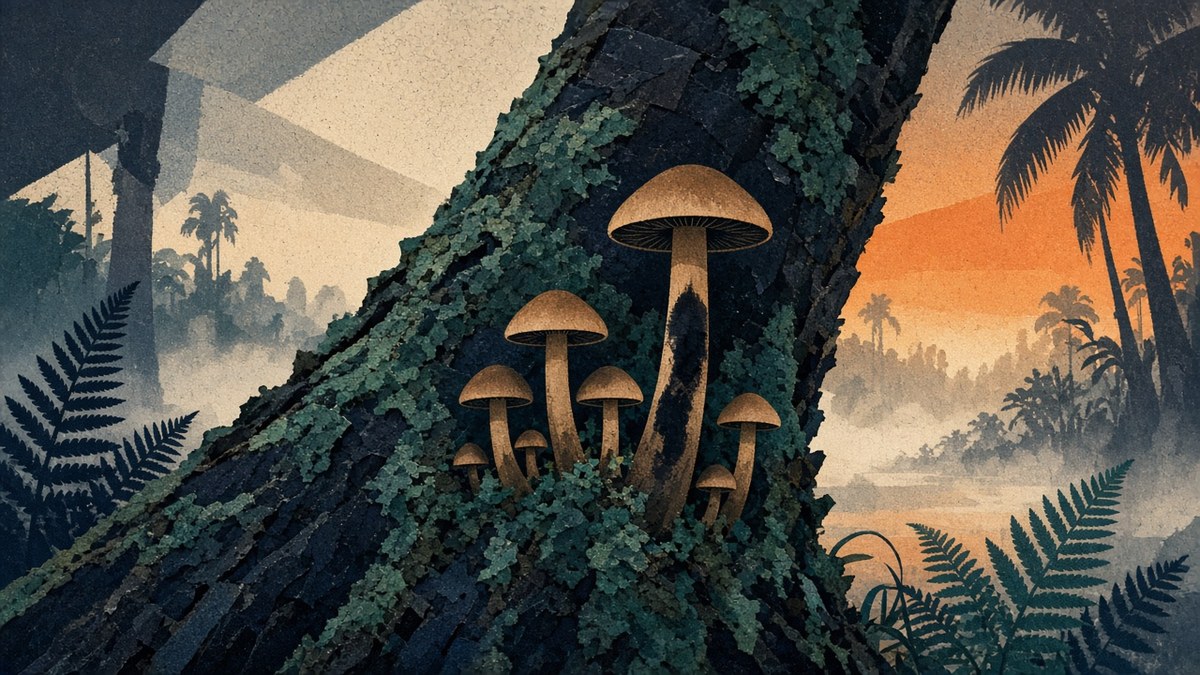
Kunik spotted it in 2025 on a moss-covered palm trunk in a central Florida forested wetland, while hunting for unrecorded deadly Galerina species — and it turned blue when handled, the classic chemical tell of psilocybin [1]. It is tiny: the largest specimens stand about 0.2 inches tall with caps about 0.1 inches wide, smaller than a thumbnail [1].
The chemistry held up under mass spectrometry. Every G. indica sample contained psilocybin, psilocin and two amatoxins — including a previously undocumented toxin the team named alpha-proamanitin, a close chemical cousin of the death cap's alpha-amanitin missing one hydroxyl group, which may make it less bioactive but still toxic [1][2]. The genome tells the stranger half of the story: the lineage appears to have made amatoxins first, then acquired the five-gene psilocybin cluster — the Psi genes — by horizontal gene transfer, genes jumping sideways from an unrelated fungus, possibly twice within the genus [1][2].
Now the caveats, because this paper prints them with the wonder, not under it. The sample base is small: five Galerina specimens collected between January 2024 and September 2025 in the southeastern United States, only three of them G. indica, with the genome drawn from one [1]. The study is peer-reviewed, but toxicity was not tested in animals or humans — nobody knows what a dose of this mushroom does to a person, and no honest report will invent one [1]. Why a fungus would carry both chemistries — the predator-defense explanation is the obvious candidate — is hypothesis, not result [1].
Kunik's own framing is the right size for the finding: "Humanity's cultural infatuation with mushrooms has long been bookended by two categories: mushrooms that induce psychedelic experiences and mushrooms that are deadly toxic. Our discovery of the 'dark magic mushroom' represents an unusual convergence of worlds, where we now know of this rare and unusual species that produces the chemistry responsible for both properties." [1] And, in the University of Florida's statement: "What's exciting is that there are small, seemingly uninteresting fungi that can conceal extraordinary chemistry that we're only beginning to understand." [1]
A fifth of an inch tall, on a palm trunk, in a swamp — carrying both of mycology's most famous chemistries, one of them stolen. The categories were ours. The mushroom never got the memo.