
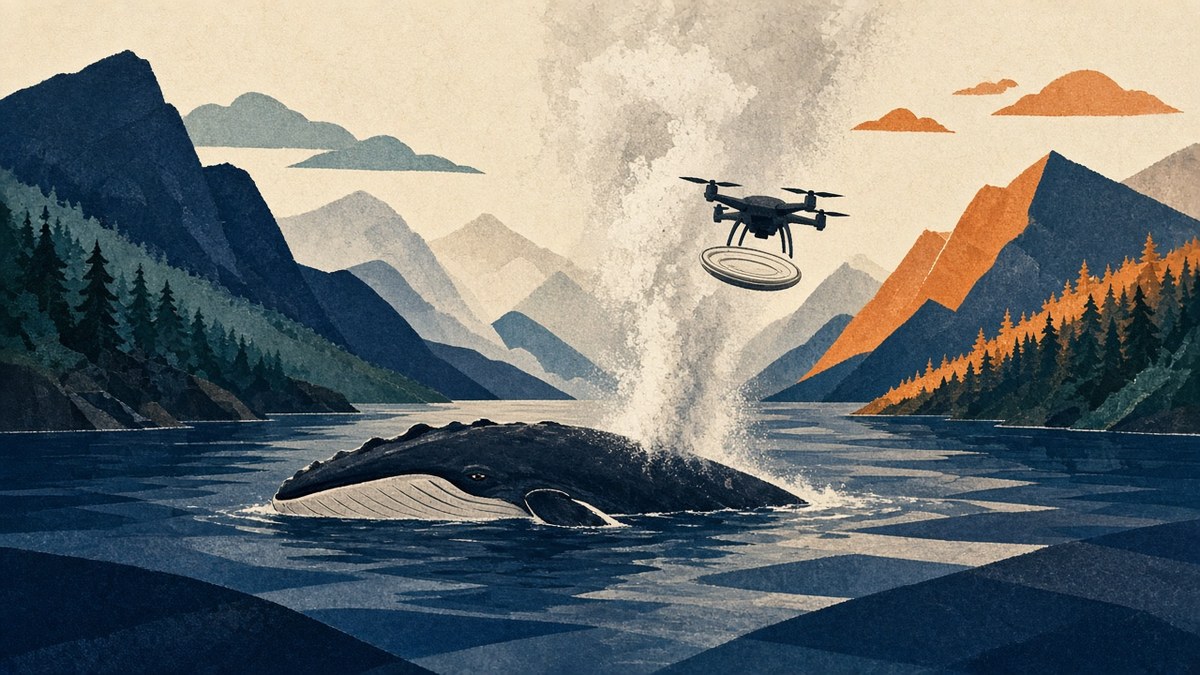
Researchers have sequenced whole humpback whale genomes from breath alone — flying a small drone through a whale's blow and reading DNA from the droplets — in what the team calls a world first [1][2].
The study, "Breath to genome: Whole Genome Sequencing of Large Whales from Blow Sampling," was published on November 17, 2026, in Molecular Ecology Resources [2][3]. The authors are from the University of St Andrews, the University of Copenhagen, the North Coast Cetacean Society, and Fisheries and Oceans Canada [2].
Until now, a whole whale genome required a biopsy — a plug of skin and blubber taken with a dart fired from a close boat — a stranded animal, or a historical specimen [1][2]. Biopsy sampling can disturb animals and, for some species and places, is not permitted or possible [1].
Instead, the team attached sterile petri dishes to a small, commercially available drone and flew it through the exhaled breath of one humpback at a time, typically collecting 1 to 6 breaths per surfacing [1][2]. Fieldwork in 2022 and 2023 took place in Gitga'at First Nation territory, in the Kitimat Fjord System of northern British Columbia, under a Fisheries and Oceans Canada research permit [1][3].
The team collected 58 blow samples from 26 individual Northeast Pacific humpback whales [1][2][3]. On average, 84% of the DNA in a sample came from the whale itself [1][2][3]. The rest, about 16%, came largely from microbes living in the whale's airways — meaning one breath could also reveal the respiratory microbiome, a potential window into health [1][2].
Coverage differed by genome type: nuclear genomes averaged 2.3-fold coverage, while mitochondrial genomes averaged 94-fold [3]. And the checks held up. Repeat samples from the same whales, across different encounters and two years, gave matching genomes, and blow genomes matched biopsy genomes from the same animals [1][2]. The method correctly determined the sex of every whale sampled, and the team found three previously undescribed mitochondrial DNA variants [1][2]. The population showed little evidence of recent inbreeding [1][2].
More than a third of samples were collected launching the drone from land, with no boat involved at all [1][2]. The team targeted the most upwind whale in a group to avoid mixing DNA, never sampled resting whales, and stopped flights if a whale reacted [1]. Before this study, only one North Pacific humpback whole genome was publicly available; this work provides a population-level dataset [1][2].
The limits are stated plainly: one species, one region, and low-coverage nuclear genomes — a proof of method, not yet a high-resolution census tool [3]. But the dart gun just got a retirement notice.