
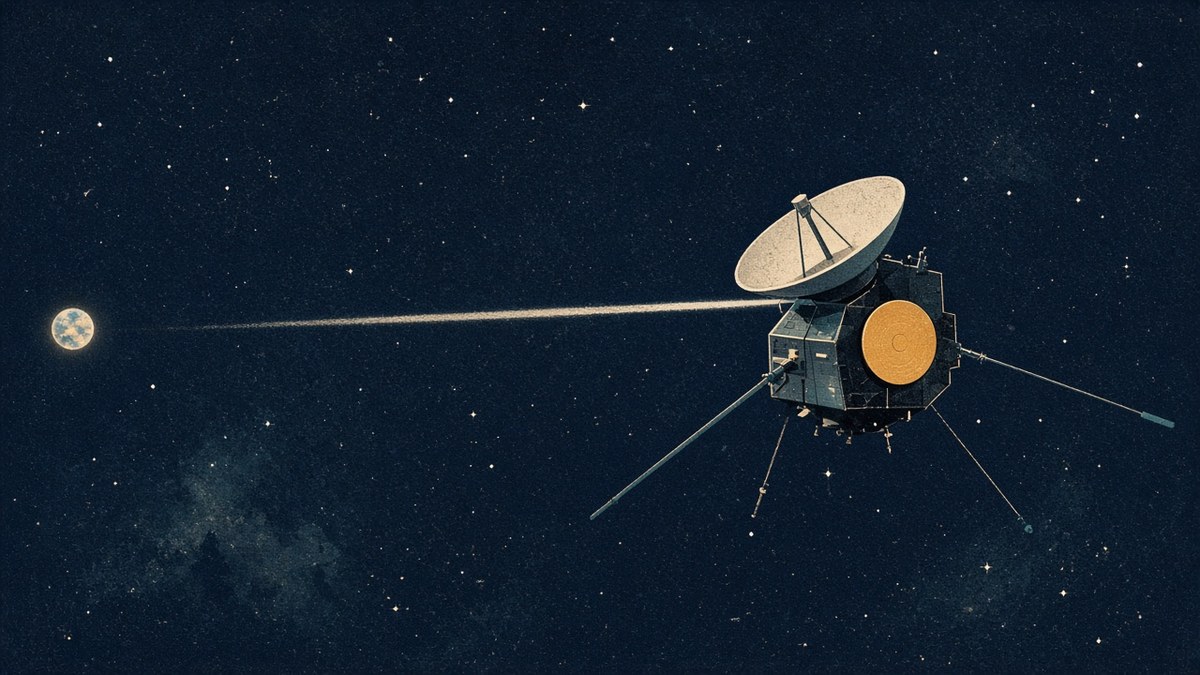
There is a machine out there so far away that light itself — the fastest thing there is — needs a full day to reach it. On Wednesday, it crosses that line.
NASA's Voyager 1 will reach one light-day from Earth on Wednesday, Nov. 18, 2026, at 5:16 a.m. Eastern, after 49 years, 2 months and 11 days of travel — the first human-made object ever to get that far. From that moment, a radio signal takes precisely 24 hours to reach it, and 24 hours to come back. Say hello today; the answer, if any, arrives in two days. The spacecraft is more than 16 billion miles away — NASA puts it at 16.1 billion miles from the Sun — travelling at roughly 38,000 miles per hour. [1][2][3]
The timeline is a history of American competence worth remembering. Voyager 1 launched Sept. 5, 1977. It flew past Jupiter in 1979 and Saturn in 1980, then kept going, and in 2012 it crossed into interstellar space — the space between the stars, where no human object had ever been. Its twin, Voyager 2, launched two weeks earlier on a slower road and will not reach one light-day until 2035. Each carries the Golden Record, a 12-inch gold-plated disc of sounds and greetings in 55 languages — a message in a bottle thrown into an ocean with no shore. [1][2]
It is still working, barely, and the barely is heroic. Only two science instruments are still running — the magnetometer and the plasma wave instrument. Earlier this year NASA shut off another instrument to conserve the spacecraft's decaying plutonium power supply, and in October controllers briefly lost contact after a September power-saving maneuver; the cause is still being investigated. The machine is dying by inches, on purpose, one switch at a time, so that the last instruments can keep talking as long as physics allows. [1][2]
"It's a national treasure," Voyager project manager Suzanne Dodd told the Associated Press. "Really extraordinary." Of the Golden Record, she said: "It's a time capsule of life on Earth from 1977. I hope something, someone, finds it maybe 1,000 years from now." Bill Nye of the Planetary Society put the mission's reach plainly: "all of us—everyone on Earth—have been touched by these missions." [1]
NASA is marking the week with "Shine Bright for Voyager's Light-Day": after sunset on Tuesday, Nov. 17, the public is invited to flash V-G-R — Voyager's call sign — in Morse code with a phone or flashlight, aimed at the sky. It is a gesture, and everyone involved knows the spacecraft cannot see it. That is not the point. The point is that a machine built by people who are mostly gone, launched the year of Star Wars, is still out there doing its job in the dark between stars — and on Wednesday, for the first time, it will be a full day of light away from every one of us who sent it.