
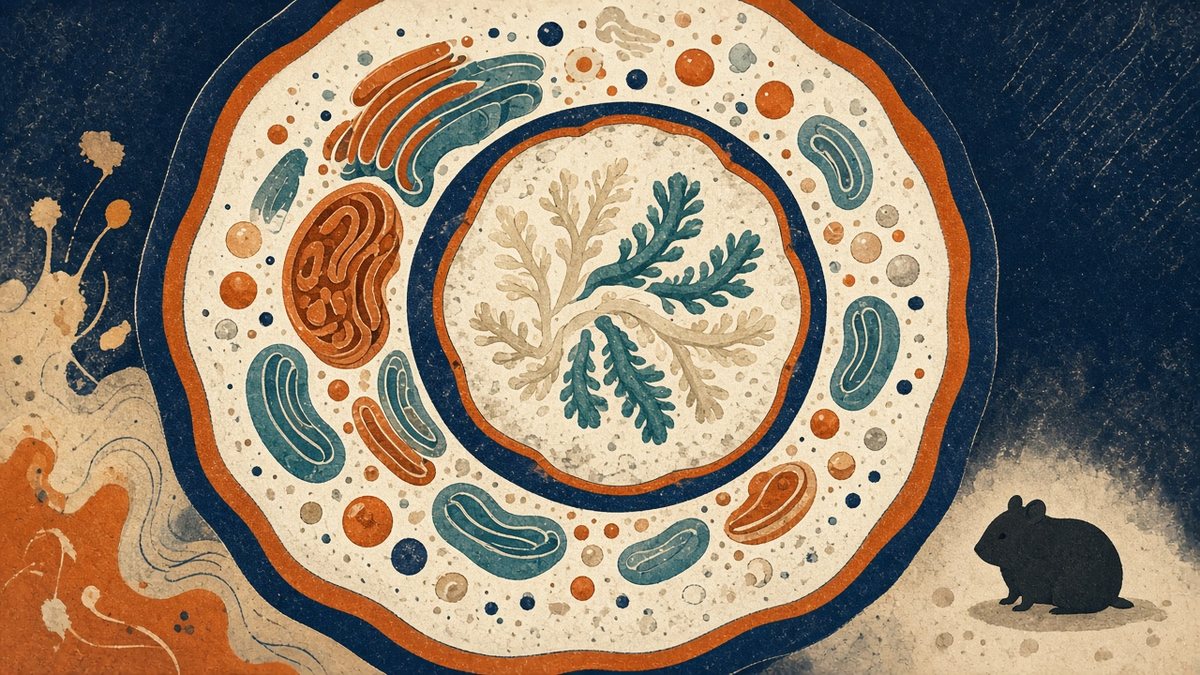
More than 1.5 billion years ago, a single cell swallowed a photosynthetic bacterium and, instead of digesting it, kept it. That guest became the chloroplast, and its genes slowly moved into the host's nucleus. Every plant and alga alive descends from that merger. [1]
A team at the University of Tokyo has tried a small, deliberate version of the trick, with an animal cell as the host.
The researchers combined a single-celled red alga, Cyanidioschyzon merolae, with cultured cells from hamsters, either by fusing the two or by letting the hamster cells engulf the algae. Fusion worked far better. [1] In one hamster-derived line, about 16.3 million base pairs of algal nuclear DNA survived, including intact chromosomes and sequences from all 20 of the alga's chromosomes. [1] Algal DNA was still detectable after 155 rounds of cell division, and large parts of it lasted 95 generations even without antibiotics forcing the cells to keep it. [1] The team calls them "planimal" cells. The results are in Nature Communications. [1]
"Plants and animals cannot reproduce with each other, so their chromosomes are never combined through mating," said Sachihiro Matsunaga, the study's senior author. "Yet, we have succeeded in creating hybrid chromosomes containing genetic material from both an alga and a mammal." [1]
The animal cells did not exactly welcome their lodger. About 96% of the transferred algal protein-coding genes showed no detectable activity. [1] The foreign DNA picked up chemical tags associated with silencing genes, and cells lacking DNMT3A, an enzyme that helps lay down those tags, formed fewer stable hybrids and kept less algal DNA. [1] The researchers call this "epigenetic gatekeeping": the host takes in the stranger's genome but keeps most of it muted. [1]
Matsunaga's long-term dream is animal cells that photosynthesize, "producing oxygen while using carbon dioxide to make useful organic compounds." [1] The university is careful to say this study did not do that. It would take working chloroplasts and much more engineering. [1] For now, the hamster cells carry a plant's library around with them. They just haven't opened the books.