
Lighthouse keepers learned long ago that a light you can't see in daylight can still be found by its rhythm. Astronomers just did something similar with a dead star hiding in the glare of a living one.
Since 2022, astronomers have been puzzling over "long-period radio transients," objects that flash radio waves every few minutes to every few hours. The ones traced so far have mostly turned out to be pairs: a white dwarf, the burned-out core of a star like the sun, orbiting a small, cool red dwarf. [1]
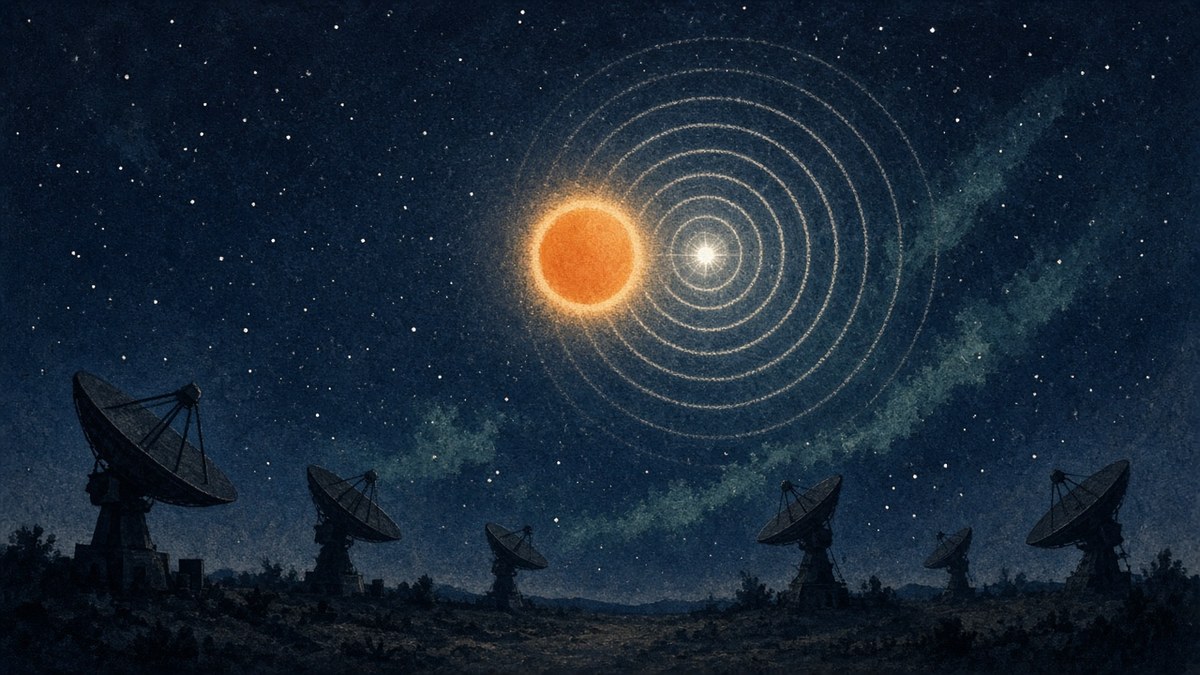
In late 2024, a team using the Murchison Widefield Array radio telescope in Western Australia caught short radio flashes "arriving like clockwork every 7.9 minutes," Curtin University astronomer Natasha Hurley-Walker writes. Then the flashes stopped for weeks. "We nearly gave up." [1] When the team plotted every detection and every silence together, a pattern appeared: about six hours of pulses, then 26 hours of nothing. The natural explanation is two stars orbiting each other every 32 hours, with the pulses visible only when they line up. [1]
South Africa's MeerKAT telescope pinned the source to a single faint star, and the Keck telescope in Hawaii took its spectrum. The surprise: it was not a red dwarf but a G-type star, "almost the same mass and temperature as our own sun." [1]
To figure out what the pulsing partner is, the team used timing. The pulses arrive up to 4 seconds early or late as the object swings around its orbit, which reveals the orbit's size, while the sunlike star barely wobbles. Put together, the hidden object weighs about two-thirds as much as the sun. That's too light for a neutron star, so the team concludes it is a white dwarf pulsar, the first found orbiting a sunlike star. [1] The work is published in Nature Astronomy, led by Samuel J. McSweeney. [1]
How did this pair end up so close? The team thinks the star that became the white dwarf once swelled into a giant and swallowed its companion, which spiraled inward before the giant shed its outer layers. [1] Hurley-Walker suspects such systems are common but hard to spot, because a bright star's glare hides a faint white dwarf. Radio pulses cut through that glare. [1]
That matters beyond curiosity. Some white dwarf pairs are thought to be the ancestors of Type Ia supernovae, the exploding stars astronomers use as "standard candles" to measure distances and the expansion of the universe. [1]