
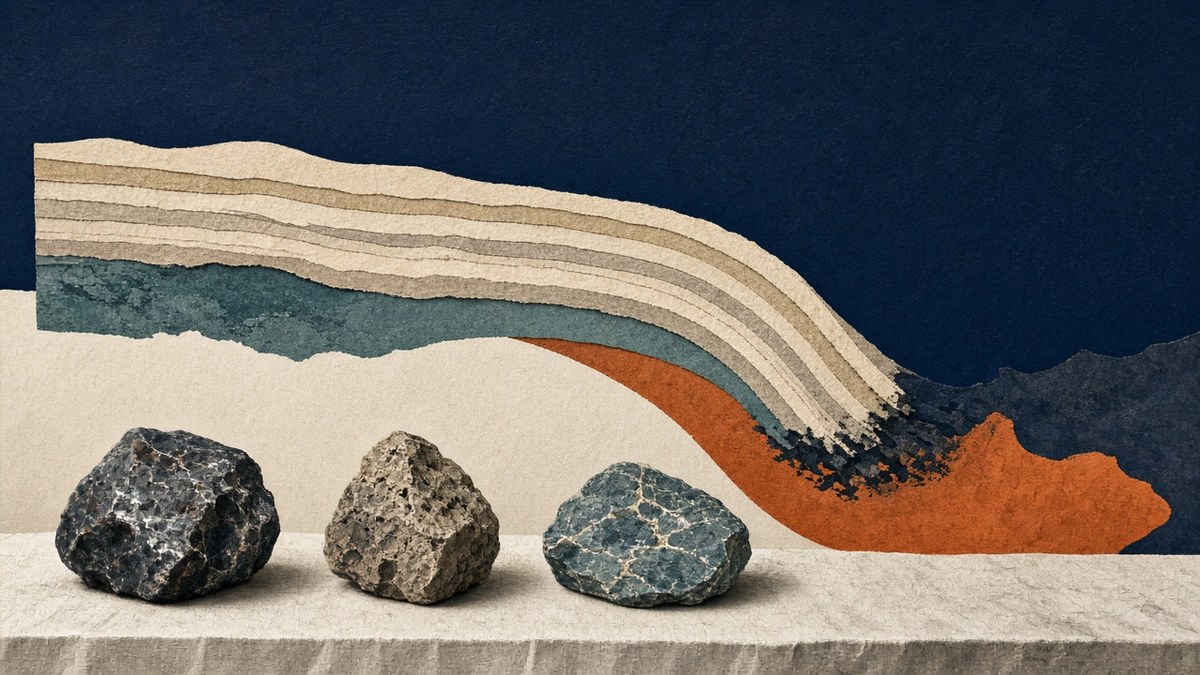
Earth is about 4.5 billion years old, and almost none of its first rocks survive. That is why three samples from northern China are getting this much attention.
Researchers led by Hangqiang Xie of the Chinese Academy of Geological Sciences in Beijing collected trondhjemitic gneiss from the Shimen Complex in Hebei province and dated it to 3.95 billion years — among the oldest rocks ever found, in a country where scientists have searched for rocks older than 3.8 billion years for decades. The dating comes from tiny zircon crystals trapped inside the rock, whose uranium decays into lead at a known rate. The study was published Nov. 14 in Nature — peer-reviewed, not a preprint. [1]
Age alone would make the paper. The chemistry is the story. Oxygen and hafnium isotope analysis, plus computer modelling, indicates the rock's material had first been in contact with water at or near Earth's surface, and was then carried more than 50 kilometres (31 miles) below the surface, where intense heat and pressure partially melted it. Something buried surface material, fast and deep, nearly 4 billion years ago. [1]
The authors' proposed mechanism is the one that runs the modern planet: subduction, where one section of crust sinks beneath another. In their words: "We propose that this rapid burial was most likely achieved through a transient subduction event." Hafnium isotopes further suggest that the process of separating material from Earth's mantle to form new crust had already begun more than 4.3 billion years ago — hundreds of millions of years before these rocks formed, when the planet itself was barely 200 million years old. [1]
Keep the claim at the size the evidence supports, because the paper does. Subduction here is an interpretation — "suggest," "propose" — drawn from chemistry and models, not a direct observation of 4-billion-year-old plates. The sample is three rocks from one location, so the finding is that something like modern plate tectonics may have been operating in at least one part of Earth nearly 4 billion years ago, not that the whole planet's crust was already recycling itself the way it does today. [1]
Even at that size, it moves the timeline. The standard picture has Earth's crust spending its first ages as a stagnant lid before plate tectonics switched on. Three rocks in Hebei say the lid may have cracked, dipped, and started swallowing its own surface almost as soon as there was a surface to swallow. The giants of geology, like the giants of everything else, appear to have started earlier than we thought.