
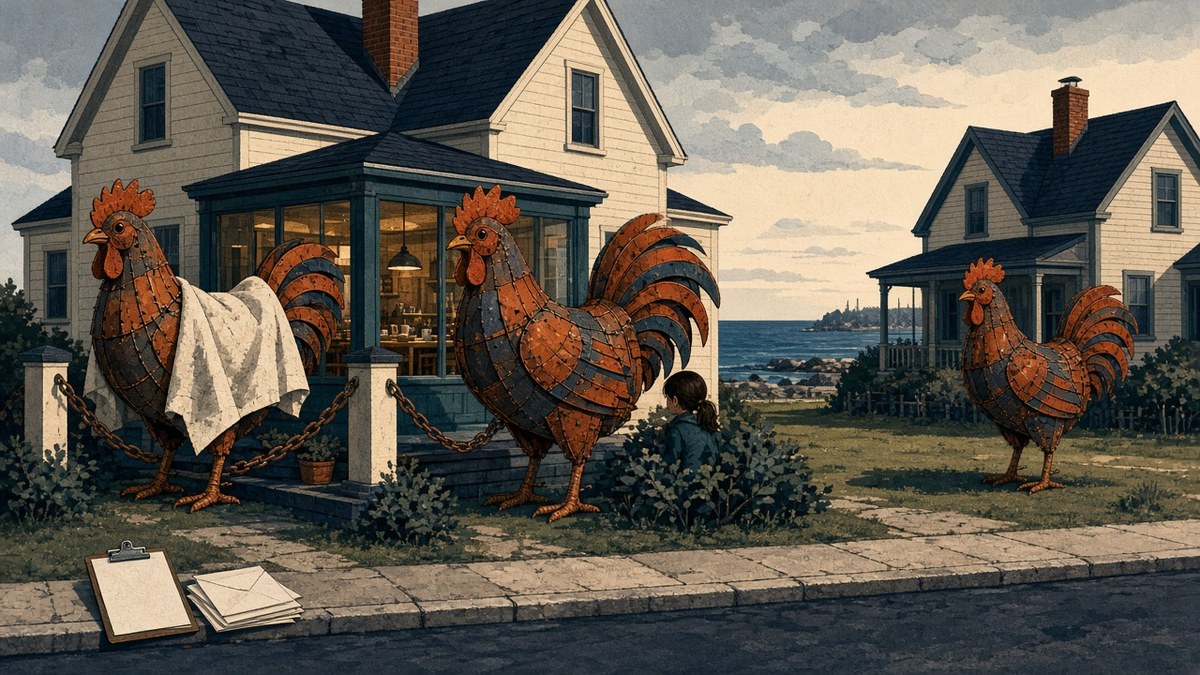
In Ogunquit, Maine, a rooster is a lawn ornament. Unless you own a breakfast place. Then, according to the town, it is an advertisement.
Dave and Sara LeBlanc first put a six-foot tin rooster in front of their Main Street home in May 2025 for their daughter, Pyper, who has autism and is now 6. Pyper loves roosters, and the statue helped her stay calm while waiting for the school bus and coming home, WMTW reported. The family collected about two dozen and never showed more than eight at once, except at Christmas, when the roosters pull Santa's sleigh. [1]
"Often times if she's unregulated that day, she'll hide inside the rooster tails," Dave LeBlanc told WGME. "The world can't see her so there's no nerves, there's no anxiety." [2]
The catch: the LeBlancs also own The Omelette Factory, a breakfast restaurant attached to the house. After the roosters became a local landmark, the couple put a rooster on the restaurant's merchandise, WMTW reported. [1]
On or about April 3, 2026, the town told the LeBlancs they had "unpermitted signage" and too much square footage of it, and ordered the roosters removed. Code Enforcement Officer Tyler McOsker told the couple the town considered the roosters ads for the restaurant, according to the lawsuit as described by WMTW. Then came the fines: $150, then $300. [1]
The family appealed. On June 11 the Zoning Board of Appeals agreed the roosters were signs, but granted a disability variance: Pyper could keep two roosters, if they were built into a railing attached to the house. The family has no railing and didn't want one. They chained two roosters to the front pillars and gave the rest to friends and neighbors. The town fined them $500 in June and $750 in September. The LeBlancs paid all $1,700 under protest. [1][2]
Here is the strange part. The same roosters, on neighbors' lawns, are just decorations. The complaint says the town has not cited anyone else displaying them, and that records the family got under Maine's Freedom of Access Act show no history of the town treating art or lawn ornaments as signs. It names lobster buoys, nautical art, antique farm equipment and large tiki statues as displays the town leaves alone. [1][3]
The town's sign code covers any "representation" that is "in the nature of" an advertisement, and caps a business's advertising signs at six square feet total, with no dimension over three feet, the complaint says. It argues that makes legality turn "entirely on what an official thinks the display means." [3] "Ogunquit isn't regulating roosters, it's regulating the LeBlancs," said Griffin Brunk, one of their lawyers, according to WGME. [2]
The Institute for Justice, a national public-interest law firm, filed the suit in U.S. District Court for the District of Maine. The complaint is dated Nov. 16, and the town was served Nov. 17, Maine Public reported. [3][4] It claims the enforcement violates the First Amendment and that the code is unconstitutionally vague, and asks for an injunction, a refund of the fines and damages. [1][2][3] Town officials did not comment, WMTW and WGME reported. [1][2]
At a press conference Tuesday, Sara LeBlanc draped a blanket over one rooster. "It will stand here as a testament to our clients' will, their constitutional rights and the town's campaign against them," attorney Daniel Woislaw said, according to Maine Public. [4]
Commentary. The law here is a sign code that lets one officer decide what a tin bird "means," then fine you for the meaning he picked. A rule that applies to one family's rooster and not the identical one next door isn't a rule. It is a permission slip. Madison wrote in 1792 that "a man has a property in his opinions and the free communication of them." [5] A town that charges $1,700 to tell a six-year-old which of her roosters are speech has forgotten that.