
For decades, Bigfoot believers have said the government knows more than it lets on. It turns out the government did have a file, and it was mostly about whether someone faked the footprints.
The U.S. Forest Service's online FOIA reading room now has a section called "Bigfoot/Sasquatch Records" with three documents: a June 18, 1982 investigation of tracks in the Umatilla National Forest, a Montana local history by Leo T. Kinney, and a 2003 Clark Fork Valley Press newspaper article. [1] Fox 12 in Portland and the New York Post both reported that the files went up on Oct. 15, about five weeks before anyone noticed them this week. [2][3]
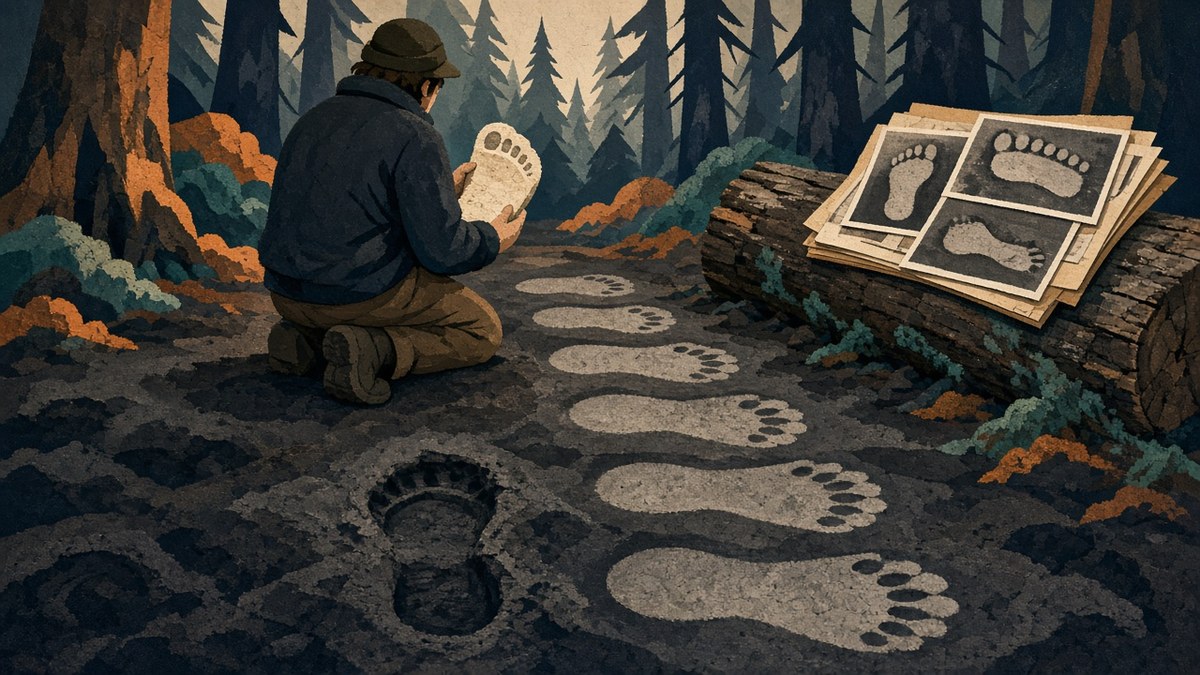
The 1982 tracks. That June, wildlife biologist Rodney L. Johnson was sent to "investigate a reported find of 'Bigfoot' tracks" in the Mill Creek watershed of the Umatilla National Forest, the Post reported. [3] Investigators photographed the prints and made plaster casts. One was about 15 inches long and 7 inches wide. [2][3] The outlets disagree on the state. Fox 12 placed the site in Oregon and the Post in Washington. [2][3] The Umatilla forest covers parts of both, and the Post noted the Forest Service office involved was in Walla Walla, Washington. [3]
Johnson's six-page memo was respectful and unconvinced. "If the tracks were faked, someone went to a great deal of trouble and detail," he wrote, according to the Post. He said some marks in the prints "would have to be very hard to duplicate" and "appear very natural." [3] His conclusion was still clear: the tracks "were made by something other than a 300 pound plus two footed being." [3] His reasons, as both outlets reported, were that the stride didn't change going up or down a slope, his own boots sank deeper into the mud than the "Bigfoot" did, and the tracks appeared and disappeared abruptly. [2][3] The Post reported that forest litter near the prints showed "obvious" signs it had been brushed aside before the prints were made. [3]
A U.S. Border Patrol tracker, identified by Fox 12 as Joel Hardin, was blunter. In a July 28 memo he called the tracks "a very clever attempt" at a hoax meant to lend credibility by involving the Forest Service, and said they were "man made by using some type of soft plaster or rubber coated foot." [2][3] Neither memo identifies who made them. [2]
The elk that disappeared. Kinney's account of Montana's Petty Creek describes a 1949 trip with three other people to recover an elk carcass, Fox 12 reported. When they arrived, only the entrails were left. Large tracks led away through the snow, and Kinney believed whatever made them had carried the carcass off the ground. They followed for about half a mile before turning back. [2] "We were not particularly anxious to catch up to whatever it was," Kinney wrote, according to the Post, and later they admitted "we all had a very uneasy feeling and could feel chills running up and down our backs." [3] A year later, he wrote, another man found similar tracks in the area, smelled a strong odor and heard grunting. Nobody saw anything. [2][3]
The 2003 clipping. The Clark Fork Valley Press article described hundreds of tracks near River Road West in Montana, one about 16½ inches long with a stride of about 5 feet, Fox 12 reported. Rain washed most of them away the next day. The paper itself said there was no solid, conclusive evidence that Sasquatch exists. [2]
So the Forest Service has a Bigfoot file. It doesn't prove anything, and that is pretty much what the file itself concludes. [2]