
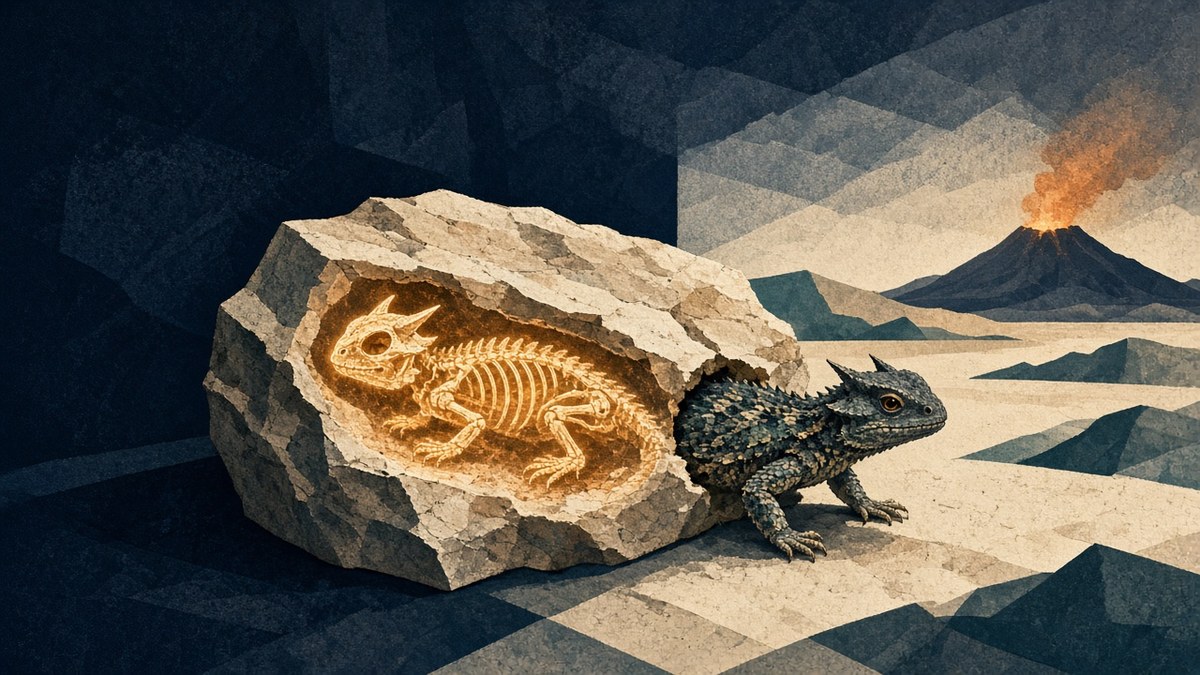
An excavation team from Switzerland's Aathal Dinosaur Museum found the fossil in August 2022 at Meilyn Quarry, Wyoming — a Morrison Formation site famous for Diplodocus, Stegosaurus and Allosaurus [1]. This one was tiny and unreadable: only vertebrae visible in a slab of sandstone, the rest hidden in rock, and nobody could say what it was [1].
The answer came from a business card. Paul Scherrer Institute researcher Pavel Trtik had left his card at the museum on a family visit in January 2023; ten days later the museum called about the unclassifiable fossil [1]. Trtik's team, led jointly with palaeontologist Torsten Scheyer of the University of Zurich, imaged it with combined neutron and X-ray tomography, sifting tens of thousands of cross-sections [1]. Trtik: "Neutrons are particularly sensitive to hydrogen. And hydrogen is also present in hydroxyapatite, a mineral component of bones. This allows us to distinguish the fossilised remains from the surrounding sandstone" [1].
Inside the rock was a reptile about 45 centimetres long that lived 156 million years ago, died in a river, and had its head detached from its torso [1][2]. It is a choristodere, a long-extinct freshwater reptile group — and, per the peer-reviewed paper, the most complete early-branching representative of the group known to date, and the oldest record of choristoderes in North America [1][2]. Its braincase, less than two centimetres across and almost completely preserved, carries inner-ear bones resembling those of living reptiles [1]. Scheyer: "They bear a striking resemblance to those of the so-called crown group of reptiles, which includes all living reptiles. This could suggest that choristoderes are more closely related to living reptiles than previous fossil evidence indicated" [1].
On the detached skull, grade it exactly as the scientist does — possible, not proven: "It's difficult to determine why the skull became detached from the torso. But we cannot rule out the possibility that a larger predator was involved" [1].
Then the name, which is why you are reading this in Strange and not only in Science. Scheyer, a Tolkien fan and a metal fan, named it Meilynodraco amonamarthi — Meilynodraco, roughly "Dragon of Meilyn," for the quarry and the two dragon-like protrusions on the back of its head, and amonamarthi for Amon Amarth, the Swedish melodic death metal band that itself took its name from Tolkien's Sindarin term for Mount Doom [1][2]. Scheyer: "When I looked at the three-dimensional images of the little reptile, with its head possibly torn off, I knew straight away: such a spectacular creature deserves an equally spectacular name" [1]. The fossil will join the travelling exhibition "Rock Fossils on Tour" at the Aathal Dinosaur Museum in early 2027, alongside other fossils named for metal musicians [1]. Museum director Yolanda Schicker-Siber: "The little dragon will be in excellent company here, with other spectacular fossils named after famous metal musicians and rock bands" [1].
A dragon the length of a ruler, beheaded in a Jurassic river, identified by neutrons 156 million years later, and named for a death metal band named for a Tolkien volcano. The categories, again, were ours.