
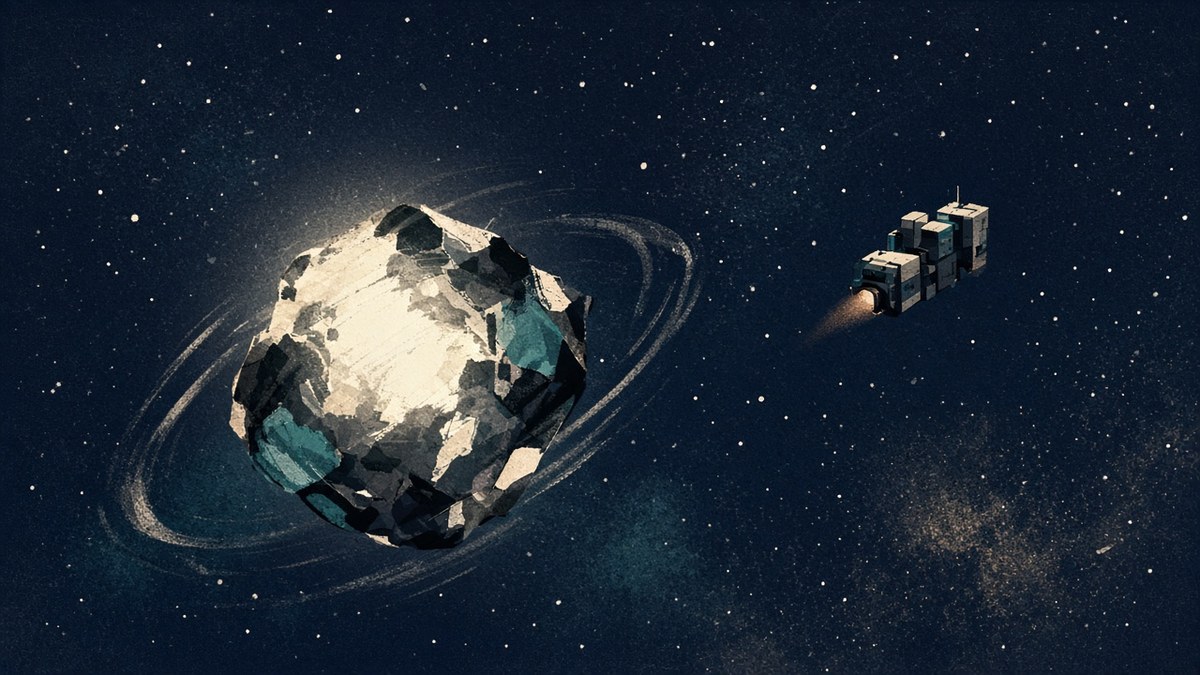
Somewhere between Earth and Mars there is an 11-metre object that behaves like no honest rock should. 1998 KY26 spins once every 5.35 minutes, reflects about 52 percent of the sunlight that hits it — far shinier than a typical asteroid — and shows non-gravitational acceleration: a push that gravity alone cannot explain, with no coma, no tail and no visible outgassing [1][2]. For years the fashionable label was "dark comet." This week the label, the leading alternative theory, and the mission meant to settle the question all moved at once.
First, the ice — or rather, its absence. A Georgia Tech study in Icarus, by Korbin Hansen and Masatoshi Hirabayashi, ran thermal simulations and found that even the coldest parts of KY26 stay above about −61°C, with an orbit average around −47°C or warmer; at those temperatures ice would be lost within roughly 2,000 years, and the water-loss rates, in their words, "preclude 1998 KY26 being a dark comet at present" [1]. Michigan State's Darryl Seligman summarized it flatly: "If something has ice, then it's a comet. But no ice meant no comet. The surface of KY26 is too warm." [1] The study's alternative is mundane physics: sunlight and thermal radiation pressure pushing on a small, shiny body.
Second, the claim that filled X this week. Harvard astronomer Avi Loeb, with Adam Hibberd and Adam Crowl, argues KY26 is Phobos 1 — the Soviet probe launched July 7, 1988, toward Mars and its moon Phobos, and lost on September 2, 1988, after a faulty uploaded command disabled its thrusters [1][2]. Their model of Phobos 1's light curve matched eight sets of observations, and the object's size and roughly 50 percent reflectivity fit a spacecraft with solar panels [1]. Loeb's X post on the object drew about a million views within a day, by his own count, and NASA Administrator Jared Isaacman addressed it on Fox & Friends on November 12: "First of all, nothing is about to hit us, to be very clear on this," and, "I've not seen any evidence to suggest this is a threat to our planet or anything other than an asteroid." [1] NASA's position stands: no known threat; the closest future pass cited is 2039, at about 10 million miles [1].
Grade the Phobos 1 claim the way this paper grades everything: Loeb's own paper calls the identification "strongly plausible but presently unproven," and that paper is not peer-reviewed. It is a serious hypothesis from a credentialed astronomer with a light-curve match — not a finding.
Third, the rendezvous that would have answered it is off. JAXA presented to a Cabinet Office space policy subcommittee on November 16 and announced on November 17 that it is abandoning Hayabusa2's planned July 2031 rendezvous with KY26, some 300 million kilometres out [2][3]. The reason is documented and has nothing to do with the debate: the last normally working of Hayabusa2's four ion engines malfunctioned in mid-August 2026 — a suspected ion-source short or power-supply failure — and cross-wiring two damaged engines cannot deliver the roughly 200 m/s the KY26 route's Earth gravity assist required [2][3]. Hayabusa2's extended-mission leader Yuya Mimasu put it plainly: "the deterioration of the onboard equipment is becoming increasingly evident" [2]. The spacecraft — flying almost 12 years, which returned samples from asteroid Ryugu in December 2020 and flew past Torifune in July 2026 — will instead fly past asteroid 2015 BM510 in April 2028, within a few hundred metres at about 6 km/s [2][3].
Loeb posted on X after the announcement: "JAXA has cancelled its planned intercept with the 'dark comet' 1998 KY26 just one day after I argued that the object may not be a comet at all, but something artificial" [2]. Print the timing, and print the whole truth with it: the engine failure dates to mid-August, three months before his posts, and no evidence links JAXA's decision to them. His suggestion that the timing is improbable is his speculation, labeled here as exactly that.
So the shiny object keeps its secret. The one spacecraft that could have flown up and looked at it is limping to a smaller appointment in 2028, and KY26 — rock, dead comet, or a lost Soviet machine that has been tumbling through the dark since 1988 — spins on, five minutes a turn, answering nothing.