
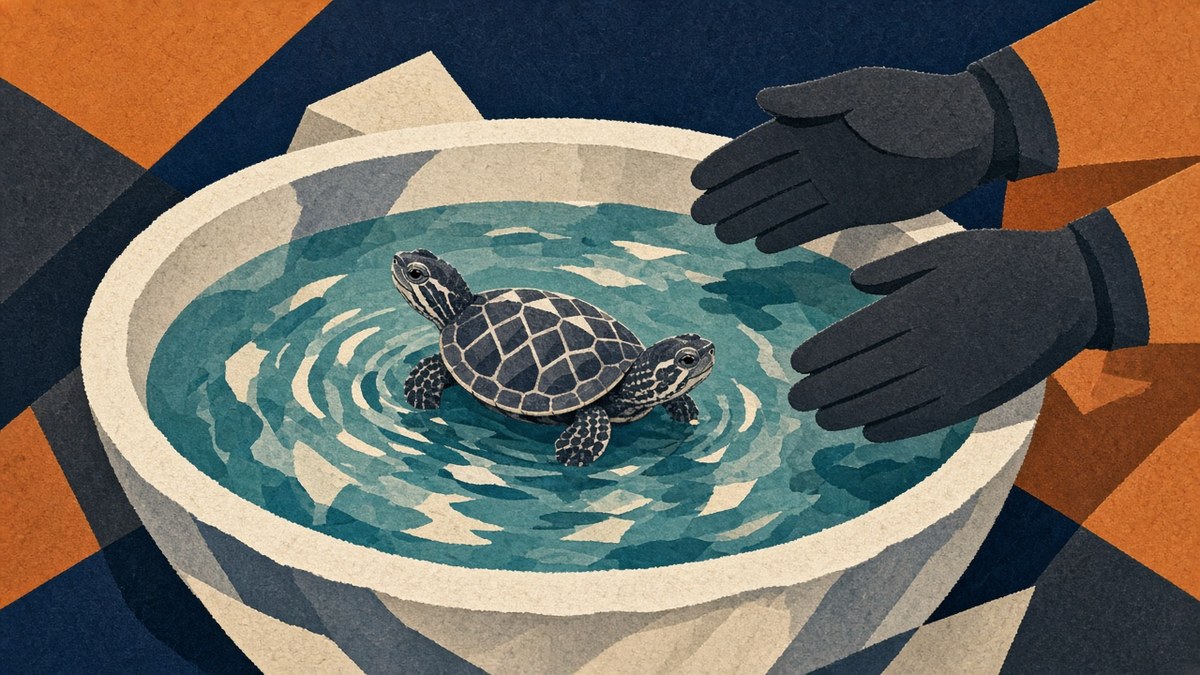
The smallest patient at the Cape Wildlife Center in Barnstable, Massachusetts, has two heads, two personalities, and one shell [1][2].
The rare two-headed diamondback terrapin — nicknamed "the twins" by staff — hatched at a protected nesting site in Wellfleet and arrived at the center on September 17 [1][3]. NBC 10 News returned to the case in a fresh report on Saturday, November 14, with video of the hatchling being weighed, held in gloved hands, and swimming in a shallow tub, and The National Press picked the story up again on November 17 [1][2].
"We call them bicephalic when they have two heads," said Dr. Priya Patel, wildlife medical director at New England Wildlife Centers [1]. Bicephaly occurs "when an embryo goes to split — like it would for twins or something — but doesn't separate fully," Zak Mertz, CEO of the New England Wildlife Centers, told Popular Science, in comments reported by Smithsonian Magazine [3].
The twins share front limbs, back limbs, and one shell [1]. X-rays show their two spines fuse at the lower neck [1][2]. When the hatchling arrived, it weighed just 5.2 grams — about as much as a nickel — and veterinarians said they would not be able to determine its sex until it gets older [3].
Shared body, different minds. Patel said each head has a distinct personality [1][2]. "The head on the left side seems to be more active... it seems to control the movements of where it wants to go more than the other side," Patel said [1]. The right head, she added, "has gained more alertness over the last couple of weeks since we've had it" [1]. Smithsonian, citing the Cape Cod Times, reported the left head has the bigger personality and was "biting the day he came in," according to lead veterinary technician Robyn Rohm [3].
That raises questions the staff are still trying to answer. "Does only one of them have to keep its head above the water and breathe? Does one of them control their movement more than the other? There's so much that we can learn about them," Patel said [1].
This is only the third bicephalic terrapin the center has had in the last five or six years, out of thousands of diamondback terrapins that can hatch every year [1][3]. The center said it is not sure what causes the condition, and that it could be genetic or environmental [1]. For now, staff are monitoring development closely and making sure both heads get nutrition and supportive care [1]. At the center, the diet has included chopped fish, bloodworms, brine shrimp and vitamin pellets [3].
Two heads, one shell, no instruction manual — and so far, both of them are winning.