
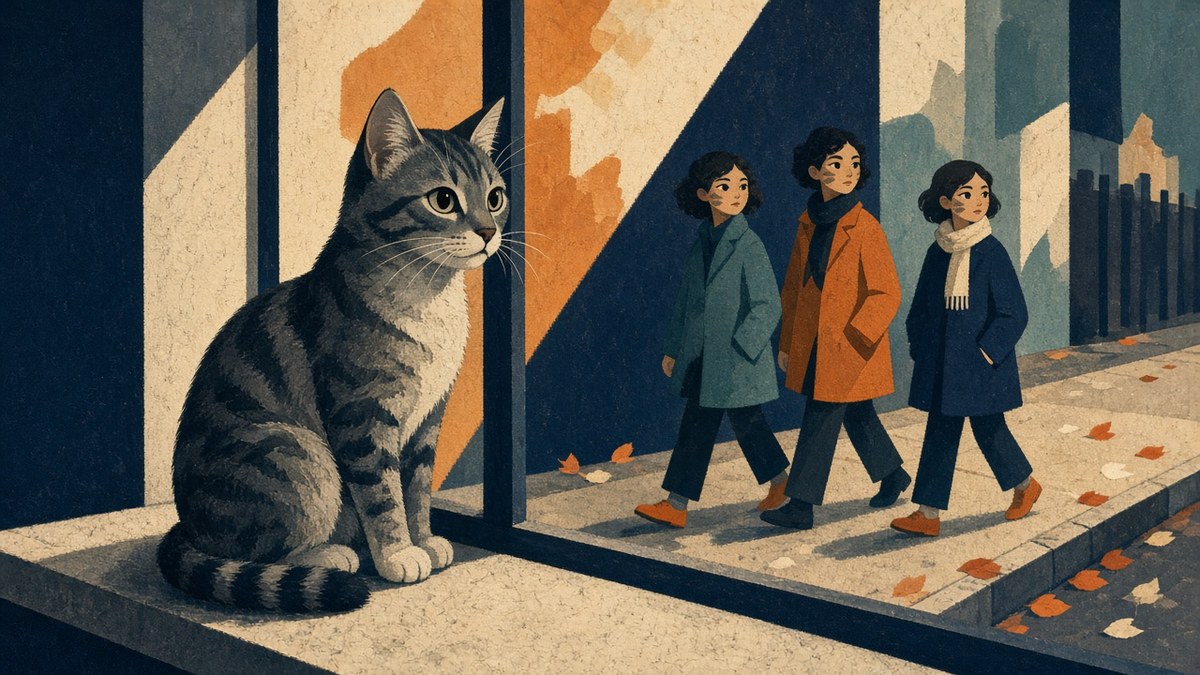
Most people's first look of the morning is a coffee cup or a phone. Karl's is often his cat. That turns out to matter for the rest of his day.
According to Dartmouth, Karl, a 28-year-old man in the northeastern United States, has a gray tabby named Luna. On some days, if Luna's is the first face he sees, he then sees her features on the human faces he meets: her almond-shaped eye sockets, her enlarged pupils, her stripes. It happens in person and online. If a human face comes first, it can flip: he may see that person's pupils and eye shape on other people, and even on Luna. [1] "These episodes often persist for several hours and occasionally last all day," the researchers wrote. [2]
According to Dartmouth and ScienceAlert, it started two years ago, after Karl had part of his right temporal lobe removed to treat an arteriovenous malformation, a tangle of arteries and veins that can cause a brain bleed. Dartmouth notes that the right temporal lobe plays a key role in processing faces. [1][2]
According to Dartmouth, his condition has a name, two in fact. Palinopsia is when something you saw earlier keeps showing up in what you see later. In Karl's case it distorts faces, which is called prosopometamorphopsia, or PMO. The case is documented by Brad Duchaine, chair of psychological and brain sciences at Dartmouth, with researchers including neuropsychologist Jennifer Nosker of Brigham and Women's Hospital. [1]
The researchers say the borrowed features do not look pasted on. "The transferred features are seamlessly integrated into the viewed face rather than appearing superimposed, and they change naturally as viewpoint or distance shifts," they wrote. [2] ScienceAlert notes that the feline features show up only on faces, not on trees or furniture, which suggests the brain handles faces differently from everything else it sees. [2]
There is a precedent, and it is just as odd. According to Dartmouth, Duchaine was reminded of a decades-old report of a woman on a bus who saw a poodle on a passenger's lap, then saw the poodle's face on every passenger. She had had a stroke nine months before. [1] Discover reports she saw the dog's face on everyone for the next 30 minutes. [3] Discover also gives the new paper's title: "Forty years after poodle-face palinopsia: Human-to-cat and cat-to-human facial feature transfer." [3] Dartmouth says the difference with Karl is that only parts of faces move, not whole faces. [1]
Dartmouth says that to show what Karl sees, Duchaine drew a sketch, ran it through an AI image model to make it look real, and then went back and forth with Karl until the pictures matched. "AI provides researchers like us with the ability to generate more accurate visualizations of what people are experiencing when they're having distorted visual perceptions," Duchaine said. [1]
One more detail is worth knowing. Duchaine's lab has heard from more than 250 people who experience face distortions, and he says some were told they had a psychiatric problem, and in some cases put on antipsychotics, when the problem was actually with their vision. [1] The team plans to keep working with Karl. Luna has not commented.