
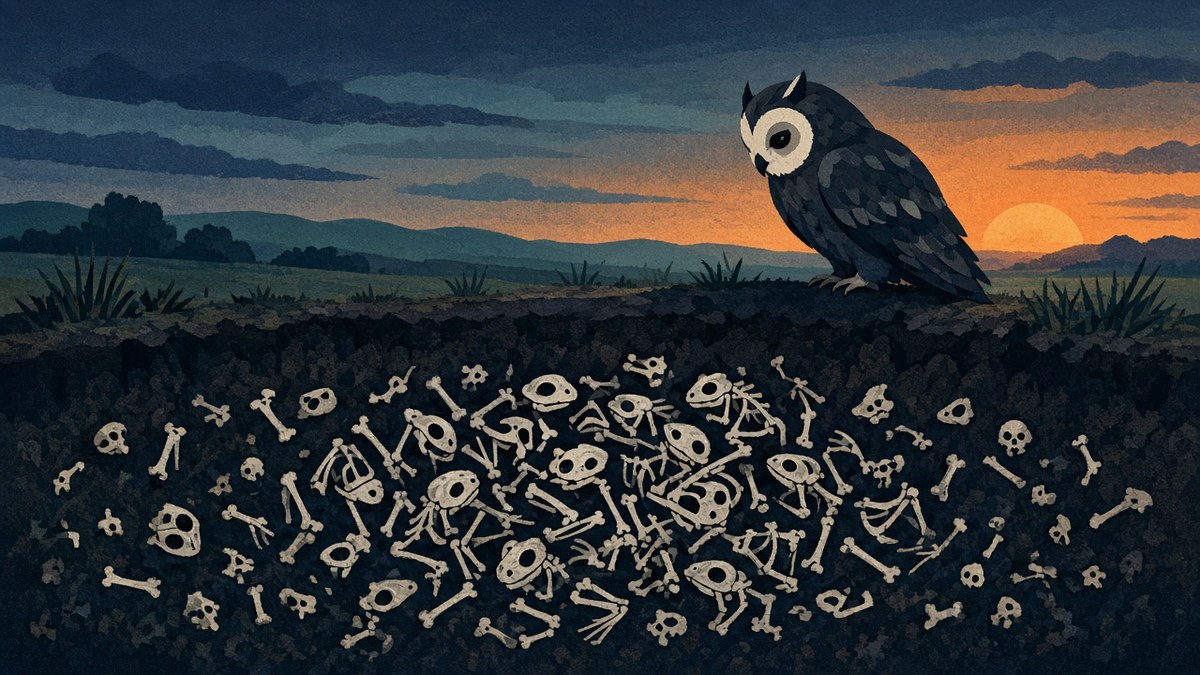
Some mysteries take a decade because the answer is complicated. This one took a decade because the answer was dinner.
During excavations for the A14 road project between Cambridge and Huntingdon in 2016–2018, archaeologists found around 8,000 frog bones in a single ditch at Bar Hill, Cambridgeshire. Not scattered — concentrated, in one place, in numbers nobody could explain. The assemblage held at least 469 individual frogs. [1][2][3]
A new analysis by Bournemouth University and the Museum of London Archaeology (MOLA) has now matched the evidence to the predator. The damage and digestion patterns on the bones — lightly digested, relatively unbroken — point to birds of prey, with short-eared owls and hen harriers the most likely culprits. Otters, herons and grass snakes were ruled out. Note the honest qualifier: the owls are inferred from the bone damage, the most likely reading — nobody watched it happen 1,700 years ago. [1][2]
Radiocarbon dating by the University of Vienna places the remains about 1,700 years ago, in the Roman period, and the ditch appears to have filled within a single year — a short, intensive season of predation, not centuries of accumulation. Most of the frogs were young, eaten in the winter of their first year, a finding reached by a pioneering method of measuring frog upper-arm bones. [2][3]
The landscape explains the feast. In the Roman period the Fen waters were retreating, leaving drying ponds that made ideal frog breeding ground, while Iron Age woodland had been cleared into open grazing land — perfect hunting country for grassland owls, with far less tree cover for a frog to hide in. A bumper crop of young frogs, an open field, and owls with all winter to work. [1][2]
"We don't often get an owl's eye view of what it was like in the past from archaeological sites," said Dr. Paul Clarkson, who led the study. His summary is the headline the ditch deserved: "The mystery of these frogs has been solved – a feast of frogs that were eaten and their bones left behind by a group of owls." MOLA's Dr. Vicki Ewens, who has spent a career on animal bones, still marvels at the raw count: "In my experience, mainly working on sites from London, we don't get that many frogs. To have so many bones coming from one ditch is extraordinary." [1][3]
The study is peer-reviewed — Clarkson and colleagues, in Environmental Archaeology — not a preprint, though the freshest coverage ran Nov. 13–15, a few days after the university's Nov. 10 announcement. Eight thousand bones, one ditch, one winter, and a group of owls who never knew they were leaving a cold case for the Romans' successors to solve.