
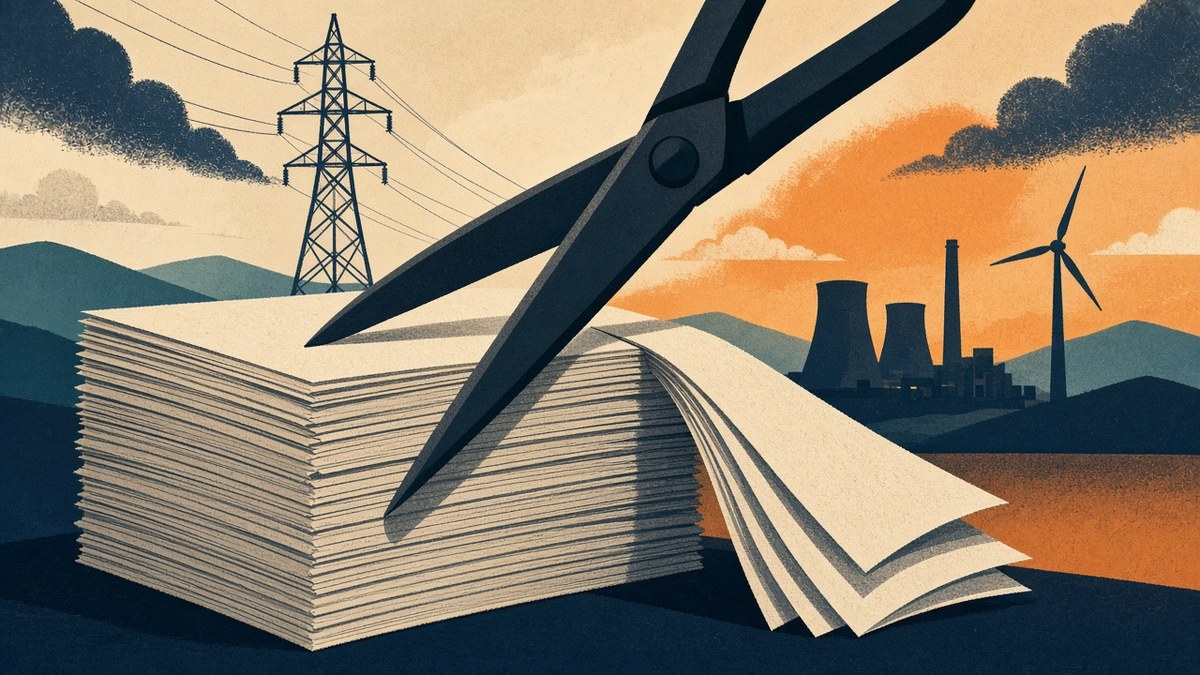
Most Power stories are about the government taking a new power. This one is about the government being asked to give some back.
The Bipartisan American Affordability and Jobs Act — BAAJA, carried in the Senate as the vehicle bill H.R. 2347 — would streamline federal approvals for power plants, transmission lines, mines and other major projects. On Monday, Nov. 9, the Senate voted 73–25 to begin debate on it. That was cloture on the motion to proceed, a procedural vote, not final passage. [1][2][3]
Today it gets real. The Senate convenes at 3:00 p.m. Eastern on Monday, Nov. 16, and at 5:30 p.m. it votes on cloture on the Capito substitute amendment — the 494-page text, posted Nov. 7, that rewrites permitting under NEPA, the Clean Water Act and the Endangered Species Act, sets 150-day windows for lawsuits, and protects permits once issued. If cloture carries, amendment votes and final passage are expected this week. [4][5]
The bill's most argued-over provision is also its most honest one: data centers would have to pay their own way. Under the Ratepayer Protection provisions, large computing sites would pay the published rate for the existing grid plus the incremental costs their demand causes, instead of spreading those upgrade costs across every household's electric bill. Sen. Shelley Moore Capito, the bill's lead sponsor, put it plainly in her floor remarks: "This section also includes the Ratepayer Protection Act, legislation that will make potential data centers pay their own way instead of American consumers facing increased costs through rising utility bills." [1][6]
Now apply the two questions this paper asks of every bill. Who has been paying for the current system? Builders who wait years for permits, towns waiting on transmission lines that never clear review, and ratepayers who would have eaten the grid costs of the AI buildout under the old rules. And what freedom does this bill cost? Very little that belongs to ordinary people — the freedom it curtails is the freedom of agencies and litigants to hold a project hostage indefinitely. That is the correct direction of travel, and both parties should be held to it: a power grab is a power grab whoever signs it, and a permission slip torn up is a permission slip torn up whoever tears it.
The opposition is organizing anyway. A letter from legal scholars urging senators to strip 12 provisions from the bill, first distributed Nov. 13, had grown to 99 signatures by Monday, Nov. 16. [7] In the House, Democrats are split. Reuters reported Nov. 14 that some House Democrats want changes and a deal this Congress, while others would rather wait until January, when their party takes control of both chambers, and write a more restrictive package. Rep. Kathy Castor of Florida is working the first track: "There's a lot of work behind the scenes right now to improve it." Sen. Sheldon Whitehouse, a lead negotiator, tied the bill's House chances to the President: "I do think that success in the House depends on the continued support from the president … and from a significant number of Democrats who support the bill." [8]
The clock is the argument. The 119th Congress expires Jan. 3, 2027. Anything unfinished dies with it. President Trump has formally endorsed the bill, with a caveat reported Nov. 9–10 that he considered it not fully negotiated and would not approve wind turbines — so his support is real but not blank. [5]
Tonight's 5:30 vote will not finish this. But it will show whether 73 senators meant it, or whether "permitting reform" is another phrase Washington says while the country waits for permission to build.