
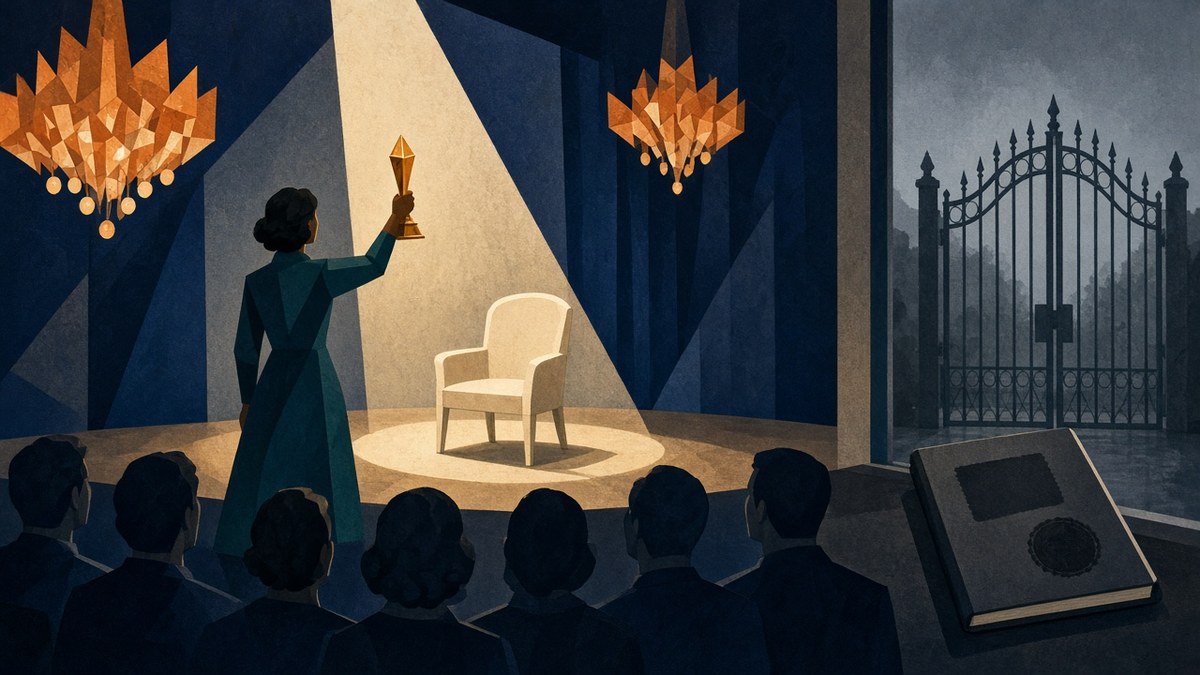
The best nonfiction book of the year, according to the National Book Awards, was written by a man who wasn't allowed in the room.
Abdelrahman ElGendy won the 2026 National Book Award for Nonfiction for "Huna: A Memoir of Revolution, Prison, and Becoming," published by Hogarth. The winners were announced Wednesday night, Nov. 18, at the 77th National Book Awards ceremony at Cipriani Wall Street in New York. [1][2] NPR reported the memoir covers the six years ElGendy spent as a political prisoner in Egypt. [3]
ElGendy was not there. In an essay in The New Yorker last week, he wrote that his visa to enter the United States from Europe was denied, NPR reported. [3] Kirkus Reviews, citing The New York Times, also reported the visa denial and quoted the essay: "My book has made it into rooms that I never will. I don't know what to do with that, and so I write." [4] Neither NPR nor Kirkus reported any explanation from the State Department.
His editor, Helen Thomaides, accepted the award and read a statement on his behalf. "Years ago in my prison cell in Egypt, I used to fantasize about writing a memoir," ElGendy wrote. "Today, that dream should've come full circle. But like so many of the circles ruptured in my life, it will remain unfinished, broken by an oppressive regime with a fascist ideology." [3]
The visa fight raised a second question: whether he was eligible at all. The awards are open to U.S. citizens and to authors who "maintain their primary, long-term home in the United States, US territories, or Tribal lands, regardless of immigration status" as of Dec. 1, 2025, Kirkus reported. ElGendy, who is Egyptian, lived in the U.S. from 2022 to 2025. [4] The National Book Foundation said the publisher told it ElGendy "was a legal and tax-paying US resident who, in the context of arrests being made by ICE in 2025, fled the United States temporarily in concern for his safety," and that this met the rules. [4] NPR reported the foundation said it had expanded eligibility in 2024 and was "proud to celebrate Huna." [3]
The rest of the winners, per the foundation: [1][2]
- Fiction: Hannah Lillith Assadi, "Paradiso 17," the story of Sufien, a man born in Palestine who lives his life in exile.
- Poetry: Brenda Hillman, "Still House in the Desert: An eco-contemplation," about her childhood home after her mother's death.
- Translated Literature: Vicente Luis Mora's "Centroeuropa," translated from Spanish by Rahul Bery.
- Young People's Literature: David Levithan and Gabriel Duckels, "The Fight of Our Lives: AIDS in America."
Salman Rushdie received the foundation's Medal for Distinguished Contribution to American Letters, and pediatrician Perri Klass, an architect of the literacy nonprofit Reach Out and Read, got the Literarian Award. Kyle MacLachlan hosted. Publishers submitted 1,912 books this year. [1][2] Rushdie used his speech to thank the late Ursula K. Le Guin: "When my first novel was published 51 years ago, it was widely disparaged. But Ursula LeGuin liked it. She was just about the only one who did. And it meant everything to me." [3]
Commentary. One of the grievances the founders listed against King George in the Declaration of Independence was that he "endeavored to prevent the population of these states," obstructing the laws for naturalization of foreigners and "refusing to pass others to encourage their migration hither." [5] Nobody is owed a visa. But a man who spent six years in an Egyptian cell for his politics, then, by his publisher's account, lived and paid taxes here, wrote a book American judges called the year's best, and got turned away with no public explanation we could find, is exactly the case where Washington owes the country a reason. A government confident in its decision would say what it is.