
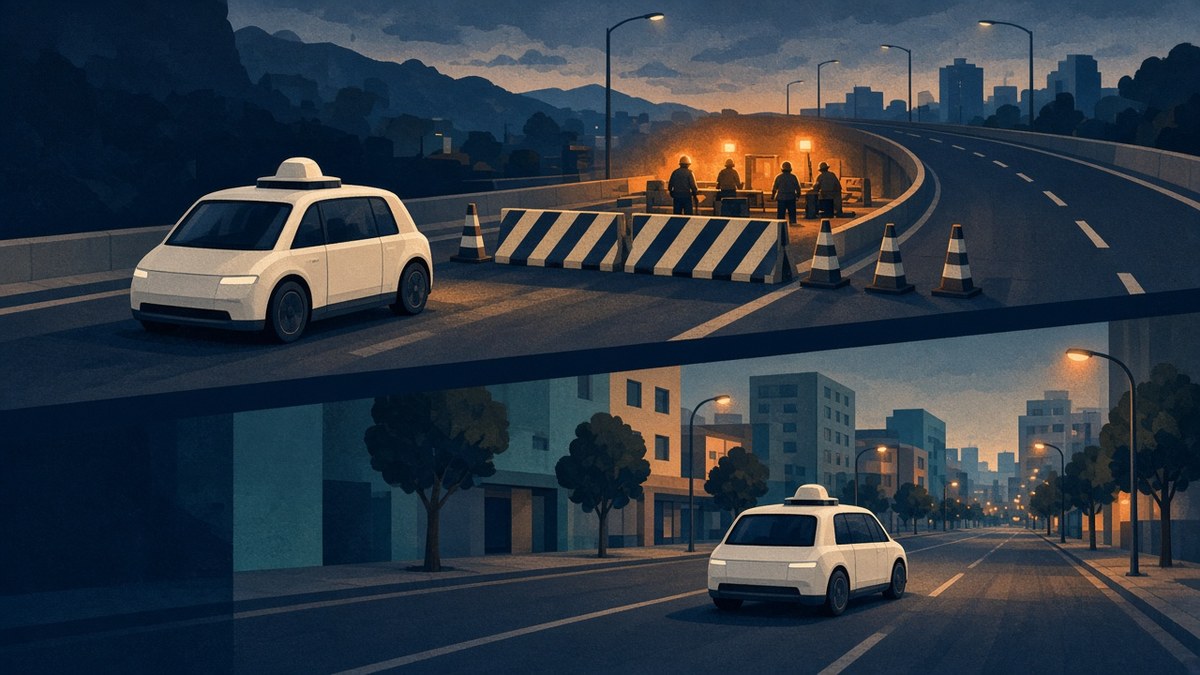
If you hail a Waymo this week, it will take the surface streets.
California's Department of Motor Vehicles ordered Waymo's driverless cars off every freeway in the state, effective Nov. 11. [1][2] The DMV said the company's driverless freeway operations "pose an imminent hazard to public safety due to recurring incursions by its vehicles into active construction zones where construction workers, vehicles and equipment are present." [2][3] The order restricts both Waymo's deployment permit and its driverless testing permit on California freeways. [2]
Two incidents set it off, according to the DMV. Three Waymo vehicles drove into an active construction closure on U.S. 101 near Burlingame. [2][3] Separately, a Waymo tried to pass California Highway Patrol cars that were running a rolling traffic break, deliberately slowing traffic behind a construction truck, on Interstate 280 in San Francisco. Video of that one went viral. [2][4]
Waymo then went further than the state asked. A spokesperson said, "In alignment with our safety-first principles, we have also temporarily restricted freeway operations across our other operating markets to evaluate our performance." [1][3] That pulls freeway rides in Phoenix, Austin and Miami, according to AFP. [4] Waymo runs driverless taxis in 15 U.S. cities but offered freeway trips in only a handful. [1] City-street service continues. [1][2]
Waymo says no one was hurt and nothing was hit in the recent construction-zone incidents, and that it is working with state officials "diligently and responsibly to resume freeway operations." [1][3]
This is not the first time. In May, Waymo paused freeway service on its own after seven of its cars drove between the cones into closed freeway lanes in the Bay Area on May 18, according to a recall filing with the National Highway Traffic Safety Administration that Patch reviewed. [2] That recall covered 3,871 fifth-generation driving systems and blamed software that could send cars into construction zones at speed. [2] Waymo restored freeway rides starting July 29 with what it said were better construction-zone detection updates. [2] The DMV says the problem persisted anyway. [2]
There is no end date this time. The DMV said Waymo must show it can safely detect and respond to construction zones, emergency vehicles and other roadway conditions, and "once that evidence is submitted, the DMV will review Waymo's corrective measures and determine whether freeway operations may safely resume." [2] The agency used powers from updated autonomous-vehicle rules adopted April 28. [2]
Waymo's own website claims its cars are involved in 95% fewer serious-injury crashes than human drivers, the BBC noted. [1] Waymo says it gives more than half a million paid rides a week. [2]
Commentary. This is the rare case where a state agency did roughly what it is supposed to do: it pointed at specific, documented failures, a car rolling into a work zone where people stand next to live traffic, and told the company to fix it. Nobody has a right to run an experiment at 65 miles an hour next to road crews. But "show us evidence and we'll decide" with no published standard and no deadline is how permits turn into permanent leverage. If Sacramento wants the public to trust the call, it should publish what passing looks like.